On the Road to the American Revolution – Walking Battle Road from Concord to Lexington, MA
Updated: Jul 20, 2025
This is not typical of the hikes that I post on this site, but as a history buff I couldn't resist writing a blog about this summer time walk. The Battle Road trail within Minute Man National Park connects historic sites from the eastern boundary of the National Park to Meriam’s Corner in Concord, Massachusetts. Much of the trail follows the original remnants of the Battle Road where Colonial militia and British soldiers clashed on April 19, 1775.

Minute Man National Park
Before starting the walk, it's worth spending a few minutes talking about Minute Man National Park. Unlike many parks known for their dramatic natural landscape like Yellowstone and Yosemite, Minute Man commemorates the opening battle in the American Revolutionary War.

Established in 1959 as a cultural landscape, the Park features farms, fields, and homes that closely resemble their appearance in 1775. Minute Man National Park's mission is to recreate the cultural environment of April 19, 1775 and help explain the events surrounding the Battles of Lexington and Concord, skirmishes along Battle Road and the ‘shots heard round the world’.
On April 19th, a contingent of 700 British soldiers departed from Boston to capture military supplies stored in Concord. Colonial express riders alerted the countryside, prompting militia companies from nearby towns and villages to gather in defense of their communities and freedoms. Following brief clashes at Lexington Green and Concord’s North Bridge, the conflict intensified along Battle Road as the British troops retreated to Boston. The fighting consisted of a series of skirmishes rather than a single intense battle. Details regarding some of the historic buildings, known as 'witness houses,' as well as key skirmishes along Battle Road, are highlighted below.
Battle Road: Walking in Footsteps of Colonial Militia and British Redcoats
The Battle Road Trail stretches between Lexington and Concord, tracing the route British troops took as they marched to and retreated from Concord. It's an amazing experience to walk on the same sand and gravel path once trodden by British soldiers and colonial Minute Men.
Merriam Corner - 12:30pm
Meriam's Corner is where the British column was first attacked on their return march to Boston by militia companies from Reading, Chelmsford and Billerica. It would be the first of many skirmishes along the Battle Road. Unfortunately, during my walk the Merriam Corner area was closed for restorations and upgrades. I needed to start my walk by following a detour around the project.
No Place to Hide
A common myth about the fighting on April 19th is that the Colonialists hid in the woods and fired on British troops. However, there were only a few woodlots available. The farming fields, which had been around since the 1600s, offered minimal cover for the militia. More commonly, colonialists found shelter behind stone walls and farm buildings. British troops experienced significant losses only in specific wooded areas.

Brooks Hill - 12:45 pm
Colonial militia followed the British column from the time they departed Concord. At Brooks Hill, around 500 militiamen launched an assault on the column. The British soldiers advanced up the hill to repel them, but the colonists held their ground and caused considerable casualties.
Bloody Angel - 1:00pm
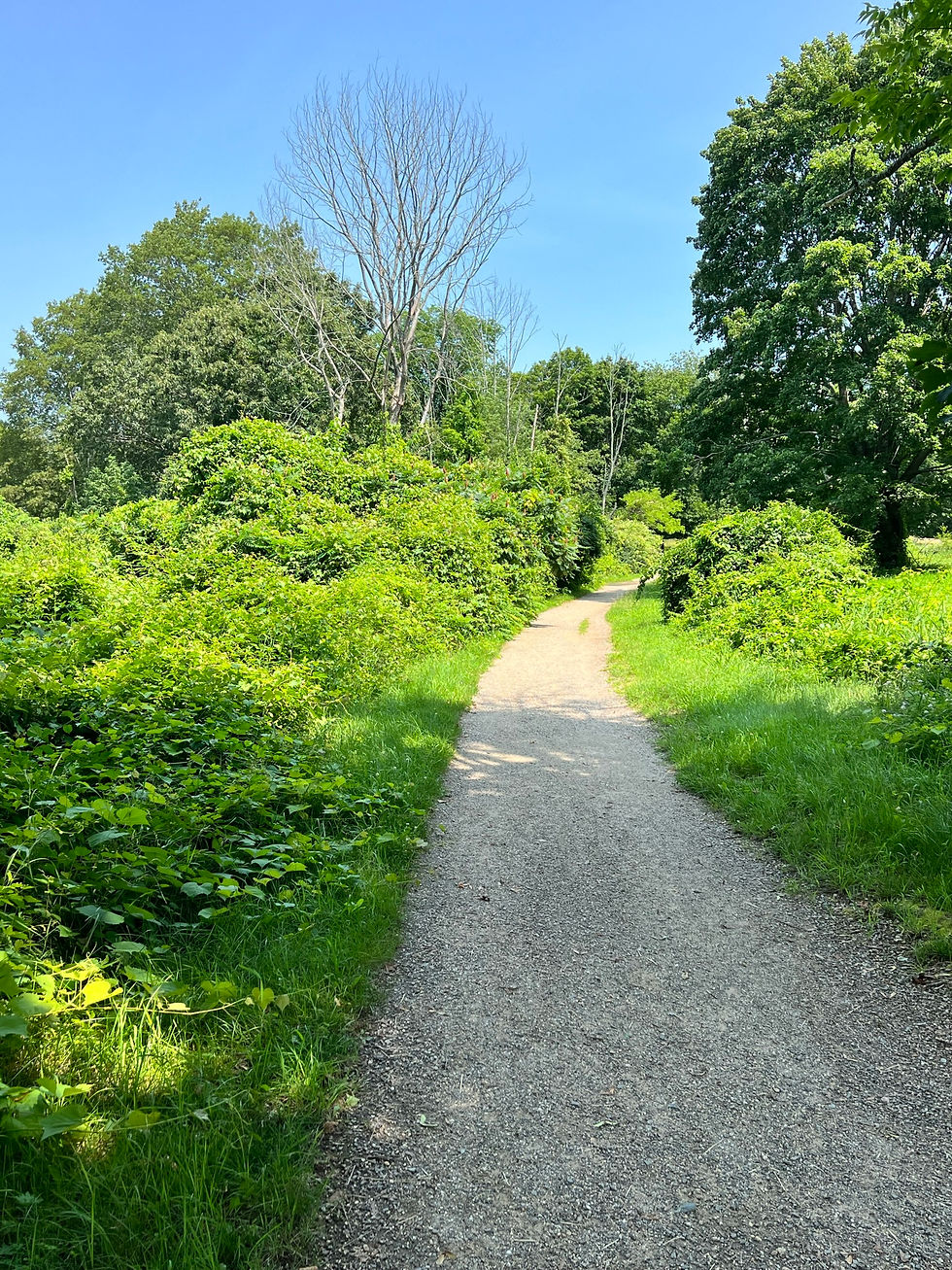
In this area, some of the fiercest fighting took place, and it would later be referred to as ‘Bloody Angel'. While much of the Battle Road landscape consisted of open farmlands, this particular section featured woods and curves in the road, enabling colonists to establish an ambush.

As the Redcoats marched through the curves, colonial militia fired upon them from both sides, catching the British in a deadly crossfire. The British experienced heavy losses, with 30 soldiers either killed or injured.

Fight Through Lincoln - 1:10 pm
A short distance away, members of the Bedford and Woburn militia took up positions behind a barn. As the British column approached, the colonists fired; once again disrupting the troops movement. Unfortunately for the colonists, the British quickly regrouped and rousted the militia who took to the field and woods to find their next vantage point.

Redcoats - A Military Marching Machine
The British column, consisting of nearly 700 soldiers, stretched over 300 yards along this road. It was an impressive force as it advanced through the countryside. An advance guard alerted them to potential ambushes, while a rear guard kept the colonialists at bay. From Meriam's Corner to Boston Harbor, the redcoats faced relentless colonial gunfire. Fortunately for the British, the colonists were mostly at a distance from the road throughout the day, so only a few of the thousands of musket balls hit their targets. Nevertheless, British soldiers fell at every hill or curve where the colonialists positioned themselves. After the column moved past one area, militiamen cut across the countryside and set up further along the road.

Hartwell House - Circa 1733
The Hartwell House, a witness house, is situated near the site of the Lincoln attack. Witness houses are historic structures along Battle Road that were present during the battles of Lexington and Concord and still exist today. Samuel Hartwell and his wife Mary resided in a house at this location from around 1765 until 1785, though some accounts suggest Mary continued living there until her death in 1846. From 1929 to 1968, the house operated as a restaurant named 'The Hartwell Farm Inn'. On the night of February 18, 1968, a fire destroyed the house, leaving only the large chimney and parts of the exterior wall intact. In 1985, the National Park Service constructed a protective structure that matches the original house's dimensions and preserves the original chimney/fireplace structure.

Smith House - Circa 1692
Located on a grassy hill near Battle Road in Lincoln, Massachusetts, stands the witness home of Catherine and Captain William Smith, who was the commander of the Lincoln Minute Men and the brother of Abigail Adams. His farm was the second largest in Lincoln. Originally constructed around 1692, the house has been restored by the National Park Service to resemble its appearance on April 19, 1775, when Captain Smith led the Lincoln Minute Men.

Paul Revere's Capture Site
In September 1774, patriot leaders initiated a system of alarms and express riders to warn towns whenever British troops marched out of Boston, On April 18, 1775, Paul Revere and William Dawes acting as express riders set out at 10:00pm to warn local militia of the 700 British troops heading to Concord. A monument along this stretch of the Battle Road, marks the location where the famous 'Midnight Ride of Paul Revere' came to an end. It was here that Paul Revere, William Dawes, and Dr. Samuel Prescott ran into a patrol of British officers who were out on the road to stop any express riders from Boston. They captured Revere (and let him go a few hours later without his horse). Dawes turned around and escaped; and Samuel Prescott made it through the ambush and delivered the alarm to Concord.

Parker's Revenge
"Parker's Revenge" refers to an important skirmish that took place during the British retreat. Captain John Parker, along with his Lexington militia, who had earlier been defeated on the Lexington Green, reorganized and ambushed the British troops as they moved through a rocky hillside, seeking to avenge their previous losses.

It was not until 2016 after a 3-year archeological project concluded that the location of the battle site was confirmed. Using ground-penetrating radar, sophisticated metal detectors and other modern-day technology, archeologists and volunteers uncovered several musket balls as well as a cast copper waistcoat button.

Whittemore House - Circa 1716
The Jacob Whittemore House is the only April 19th witness house in the park that is in the town of Lexington. In 1775, it was the home of Jacob Whittemore; his wife, Elizabeth; their daughter, Sarah; Sarah's husband, Moses; and their three small children. Neither Jacob nor Moses fought with the Lexington militia on April 19. They lived in this home from its construction until 1780 when it was sold by the family. Paul Revere passed by here on his midnight ride. Later the British column passed by here on their way to Concord, and back again in the afternoon during their retreat to Boston.

The Bluff and Fiske Hill - 1:40 pm
The fighting grew more intense as the struggle along Battle Road wore on. In the stretch between the bluff and Fiske Hill, the British troops began to fall apart. British soldiers were outnumbered by approximately 1,600 Colonial militia members opposing fewer than 700 British Regulars. Additionally, they were nearly out of ammunition and completely fatigued.
As more than a thousand Colonial militia rapidly approached, British troops ascended the sides of the bluff. From their vantage point, they spotted the advancing militia and began firing to safeguard the British soldiers moving towards Fiske Hill.

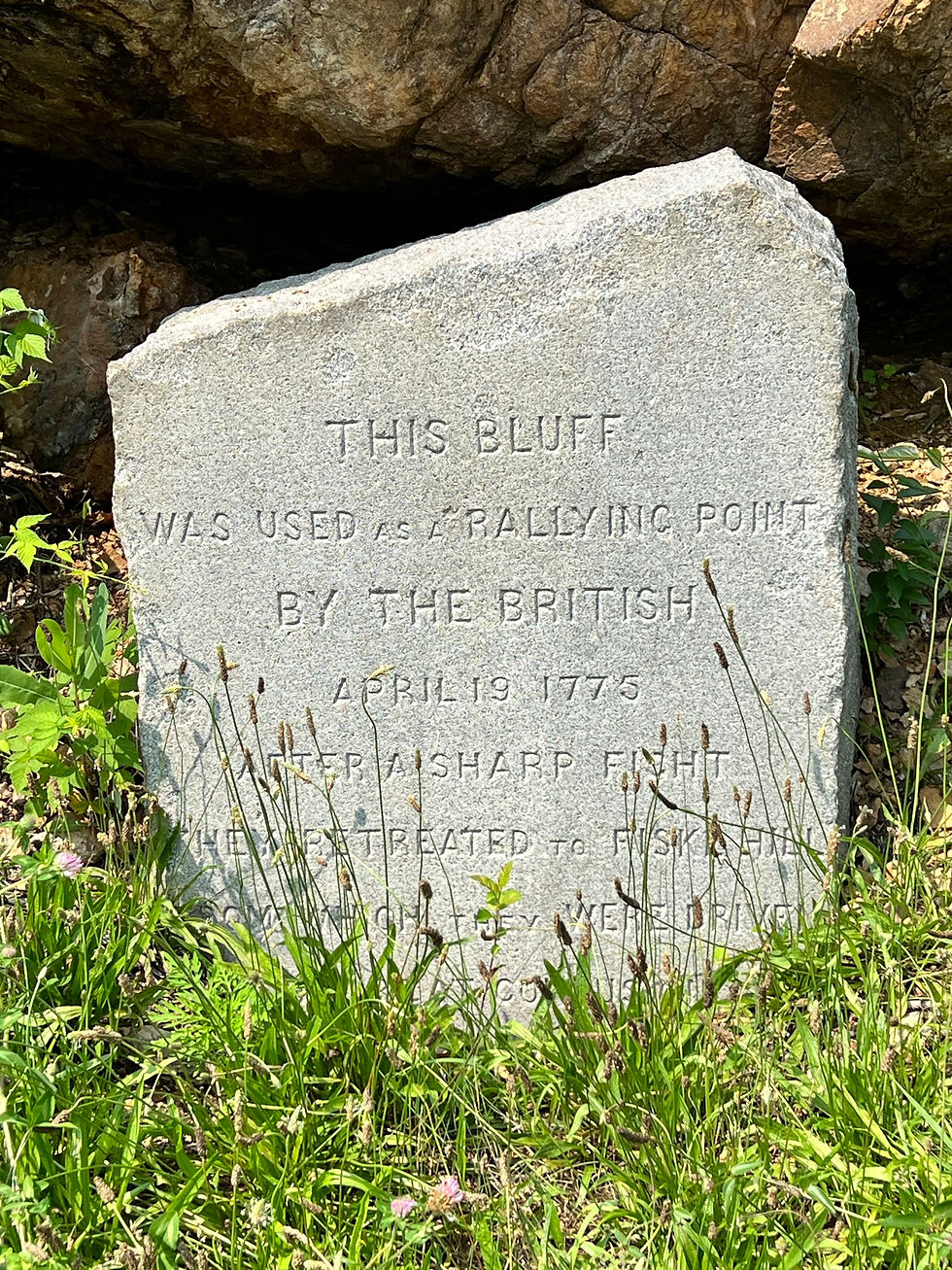
As the soldiers on the bluff retreated, they were ambushed by colonists concealed behind trees, rocks, and fences.


When the British regulars reached the top of Fiske Hill in Lexington, they encountered a barrage of musket fire. There was no place for British soldiers to regroup. To avoid complete disaster the soldiers broke rank and rushed onward, leaving their dead and wounded strewn across the landscape.

In the area of the fighting, historians recorded the burial of at least two British soldiers. The fighting in this area had been short but fierce.

Fortunately for the British soldiers, a relief brigade of 1,000 additional soldiers and two artillery pieces had arrived in Lexington to resupply the fractured British column. After taking time to reorganize and tend to the wounded, the refreshed British Column left Lexington for Boston around 3:30 p.m. When the British forces returned to Boston around 7 pm, they had suffered 73 fatalities, 174 injuries, and 26 missing soldiers, while estimates of Colonial casualties were estimated at 49 killed, 41 wounded, and 5 missing.
Although the 'shot heard 'round the world' is commonly associated with the Battles of Lexington, and Concord, it’s evident that the skirmishes of April 19th that raged over 16 miles along the Boston to Concord but especially along this 5 miles stretch on Battle road between Concord and Lexington we’re just as significant
Concord Old North Bridge
No visit to Minute Man National Park would be complete without a visit to Concord's North Bridge or Lexington Green. Having visited the Green several times, I choose to go to North Bridge.
Setting the Stage for Conflict
Thomas Gage was appointed Royal Governor of Massachusetts in 1774 and tasked by the British Parliament with stamping out rising unrest caused by restrictive British policies. By April 1775, Gage was facing the threat of outright rebellion. He hoped to prevent violence by ordering a force of 700 soldiers to march to Concord and seizure of weapons and powder being stored there. In Lexington, the troops were fired on by a small ineffective colonial militia. The militia was outnumbered and fell back, and the British troop proceeded on.
Arriving in Concord at approximately 8:00 am, British commanders Francis Smith and John Pitcairn order several companies, about 220 troops in all, to secure the North Bridge across the Concord River and then continue on another mile to the Barrett Farm, where a cache of arms and powder was presumably located.

A growing assembly of close to 400 militia from Concord and the surrounding towns gather on the high ground, where they see smoke rising from Concord. Mistakenly assuming the Redcoats are torching the town, the militia companies advance.

Opening Salvo - Minute Men Order to Fire on British Soldiers for the First Time
As the Minute Men march down the hill, the British soldiers, intimidated by their numbers and orderly advance, retreated to the opposite shore and prepared to defend themselves. When Davis’s company came within range, the Redcoats opened fire and the Minute Men responded killing three British soldiers and wounding nine others. This initial volley is considered 'the shot heard round the world'. and sent the British troops retreating back to Boston. What followed on their retreat were the skirmishes along Battle Road.


Comments