Explore Eagle Canyon and Jane Hoffbrau Palm Oasis On a Short Hike in Palm Springs
Updated: Jul 19
Why Hike Eagle Canyon
At first glance, Eagle Canyon doesn't seem all that remarkable. The trail begins on dry, rocky foothills overlooking Palm Springs, and there are no towering peaks, dramatic slot canyons, or expansive palm groves waiting around the next bend. Yet this short hike tells a fascinating story.
As you climb through the foothills of the Santa Rosa Mountains, you'll literally walk across the debris shed from mountains that continue to rise along the San Andreas Fault. Along the way, you'll discover how uplift, erosion, and fractured bedrock have worked together to create an unlikely desert oasis hidden inside a narrow canyon.
Jane Hoffbrau Palm Oasis may be smaller than famous groves like Palm Canyon or Willis Palms, but that's exactly what makes it so interesting. Unlike larger oases that depend on extensive watersheds, this oasis survives because fractures in the underlying rock concentrate groundwater into a small canyon, creating the conditions California fan palms need to thrive.
By the end of the hike, you'll see Eagle Canyon differently. It's not simply a pleasant walk to a palm oasis; it's an opportunity to learn how to recognize the subtle clues that reveal where groundwater lies hidden beneath one of the driest landscapes in North America. Once you understand those clues, you'll start seeing the desert with entirely new eyes.
Hike Details
Location: Foothills of the Santa Rosa Mountains
Trail Type: Out and Back
Distance: 3.9 miles
Elevation Gain: 682 feet
Difficulty: Moderate
Terrain/Obstacles: Eroded trail along the foothills.
Hike Breakdown: Hike is suitable for novice hikers who want a challenge
Best Time: October - May
Highlights: Hiking in the Santa Rosa Mountain foothills, desert fan palm oasis, stunning geologic landscape.

TrailsNH Hiking Difficulty Calculator: 73 – Moderate
Click here to navigate to the TrailsNH website for a description of the hiking difficulty calculator.
Let's Start Hiking
The trailhead for Eagle Canyon, more commonly known as the Jane Hoffbrau Oasis Trail, is located at the end of Palm Hills Drive in Palm Springs. Multiple trails begin here, but head toward the gate and follow the dirt road to start your hike.
Although the trail is named for Jane Hoffbrau, many hikers know little about the woman behind the name. Hoffbrau was a Palm Springs horsewoman, conservation advocate, and longtime supporter of the desert trail system. Her family name is woven throughout the area's hiking history, with the nearby Lykken Trail named after her father, Carl Lykken, and the Boo Hoff Trail honoring her husband. We'll learn a little more about her when we reach the oasis that now bears her name.

This road was originally built to provide access for a housing development that never materialized. Today, it serves the Coachella Valley Water District as an access road to its water storage tanks, while hikers use it as the gateway into one of Palm Springs' lesser-known palm oases.
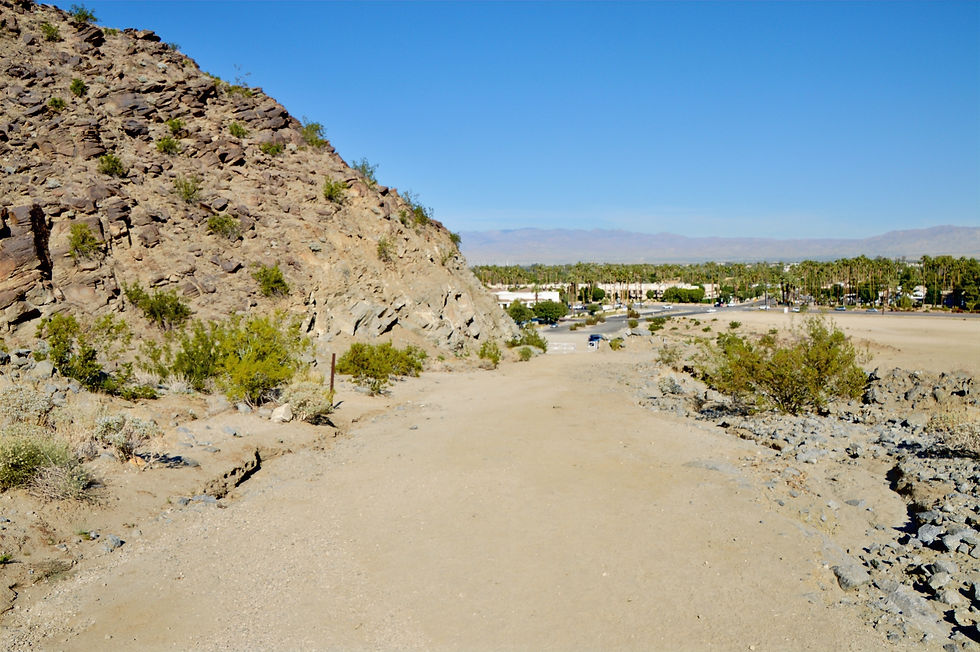
The trail begins on the lowest foothills where the Santa Rosa Mountains begin to rise out of the Coachella Valley. This transition is no accident. Palm Springs sits directly along the San Andreas Fault system, where the Earth’s crust has been fractured, shifted, and lifted rapidly relative to the valley floor.

After 0.3 miles and a few hundred feet of elevation gain, we reach a small plateau that provides excellent views of the valley.
Read the Landscape
That broad, flat bench isn't just a convenient place to catch your breath; it's a clue to how the Santa Rosa Mountains were built. Rather than rising as a single block, the mountains were uplifted along multiple faults, with different sections moving at different times and rates. As tectonic activity shifted over hundreds of thousands of years, some blocks continued rising while others were left behind, creating the step-like terraces you see along the mountain front today.
The next time you hike in the Coachella Valley, look for these flat benches. They're evidence that the landscape has been shaped by repeated movement along the San Andreas Fault system.
The road continues, but we decided to follow an eroded path rather than stay on the road. Both routes take you to the same location, and personally I’d rather be climbing up hills than slugging on an abandoned road.

Climbing the Foothills
We aren’t hiking on bedrock; we are climbing the Santa Rosa 'foothill apron'. The apron is a thick accumulation of rock debris, sand, and cobble shed from the rising mountains above us.

These dark metamorphic rocks formed deep underground long before today's mountains existed. As the Santa Rosa Mountains were uplifted, the granite pushed upward, fracturing the older metamorphic rocks. Gravity then carried the broken rock downslope, creating the blanket of angular boulders you're hiking across today.
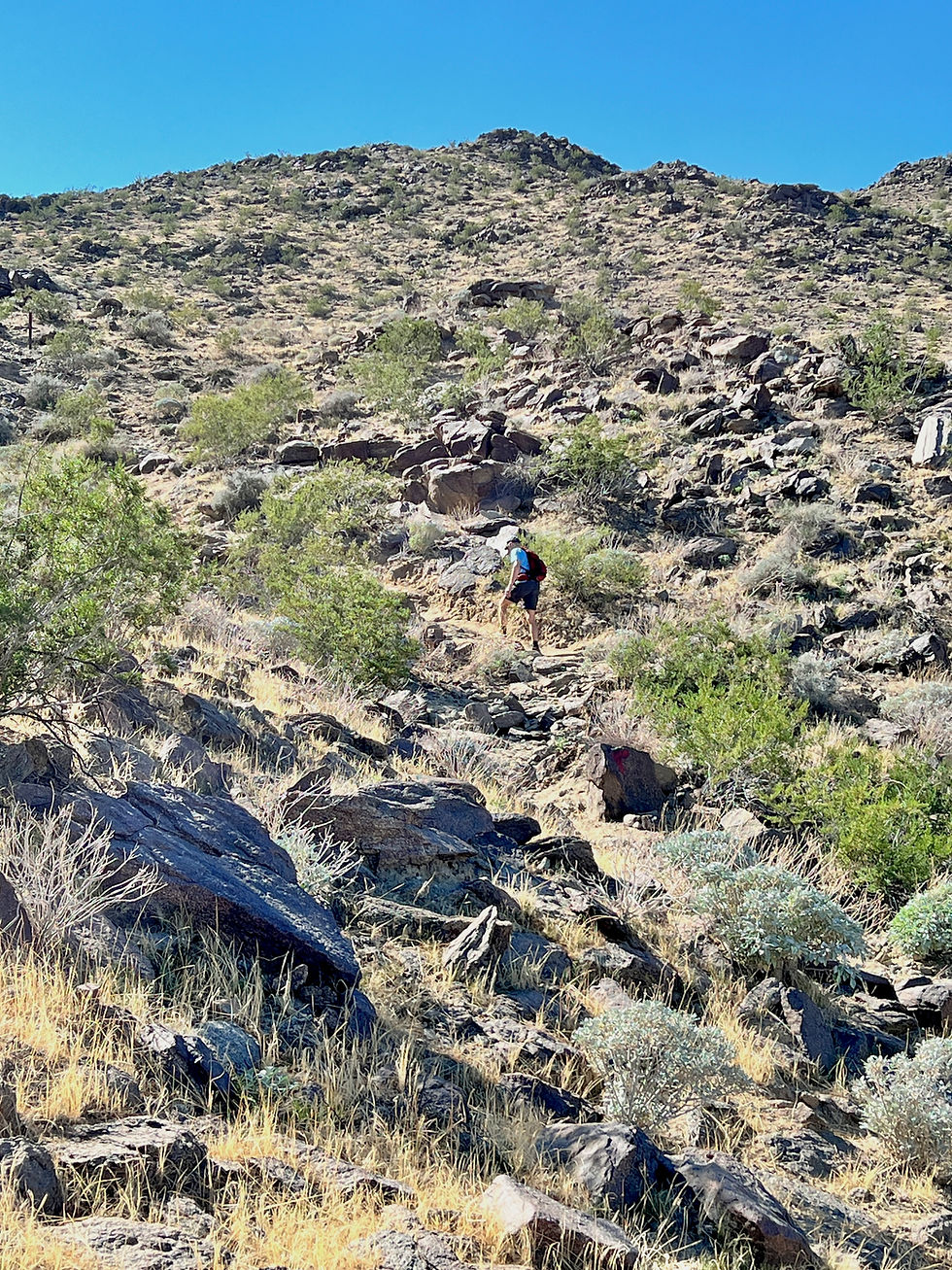
Rockfalls, landslides, and debris flows have been carrying fractured metamorphic rock downslope for hundreds of thousands of years, a process that continues today as the Santa Rosa Mountains slowly rise. Every step uphill is across material shed from the slopes above, creating the jumbled landscape of angular boulders, cobbles, and smaller rocks with little sorting that characterizes these foothills.

From the plateau, the pyramid-shaped summit of Murray Hill stands prominently above the valley. Although modest in elevation, it's another excellent hike for exploring the geology of the Santa Rosa Mountain foothills.

We continue hiking across the broad plateau before beginning our descent into Eagle Canyon. Looking back, it's easy to appreciate just how abruptly the Santa Rosa Mountains rise above the Coachella Valley.

Around 1.1 miles into the hike, a small cairn marks an easy-to-miss trail branching left into Eagle Canyon. It's a subtle turn, but one worth watching for.
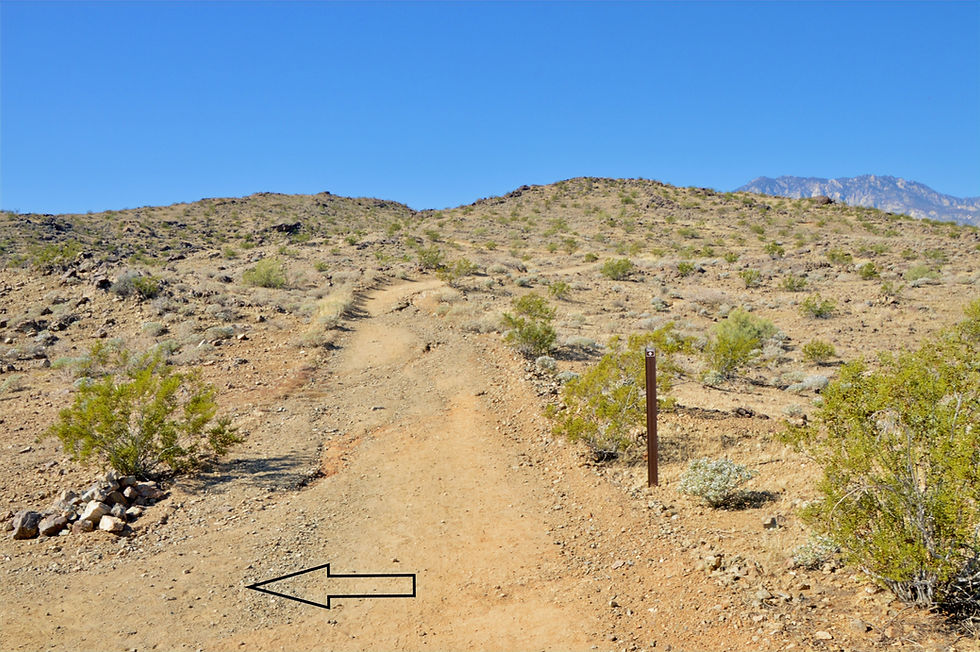
Heading into the Eagle Canyon and Jane Hoffbrau Palm Oasis
After a few minutes, the broad foothills are suddenly interrupted by a deep canyon slicing into the mountain front. At first glance, it looked like just another rocky ravine, but this canyon tells a very different story. Beneath its fractured bedrock, groundwater is quietly making its way to the surface, creating the conditions that allow a thriving stand of California fan palms to survive where most people would least expect it.

The trail into Eagle Canyon is less than a half-mile long, but every step brings a noticeable change in the landscape. The broad foothills narrow into a rocky canyon, signaling that you're entering a place where fractured bedrock and groundwater, not just rainfall, begin to shape the environment.

Entering Jane Hoffbrau Fan Palm Oasis
Standing beside the oasis is a sign honoring Jane Hoffbrau, whose lifelong connection to Palm Springs' trails inspired the name of this hidden oasis. As mentioned earlier, her family helped shape much of the local trail system, with the Lykken and Boo Hoff Trails also commemorating members of her family. It feels fitting that this quiet oasis now carries her name, recognizing someone who spent a lifetime encouraging others to experience the desert.
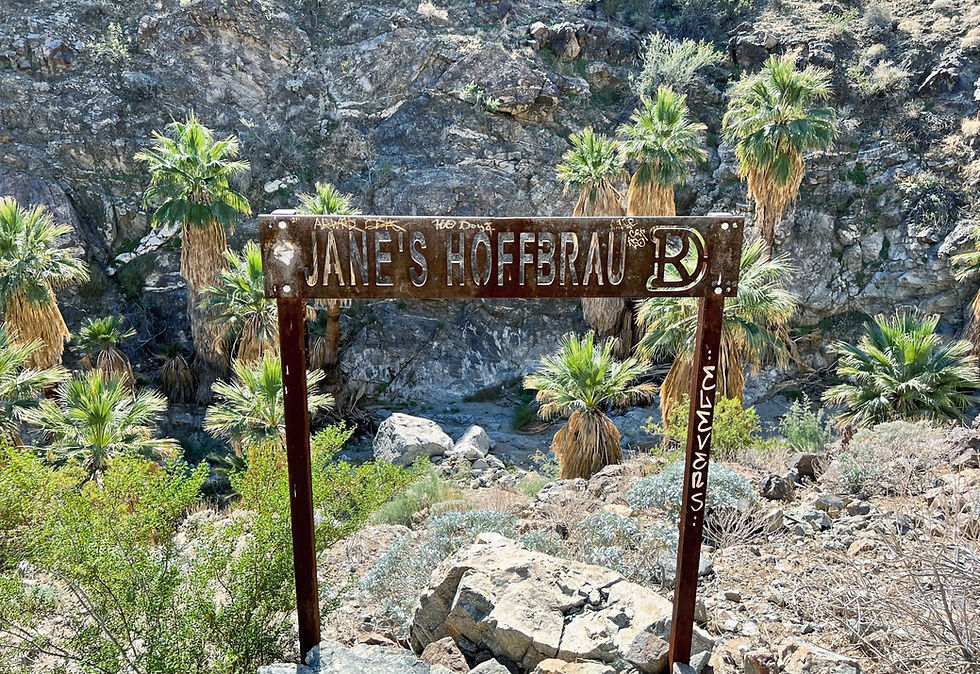
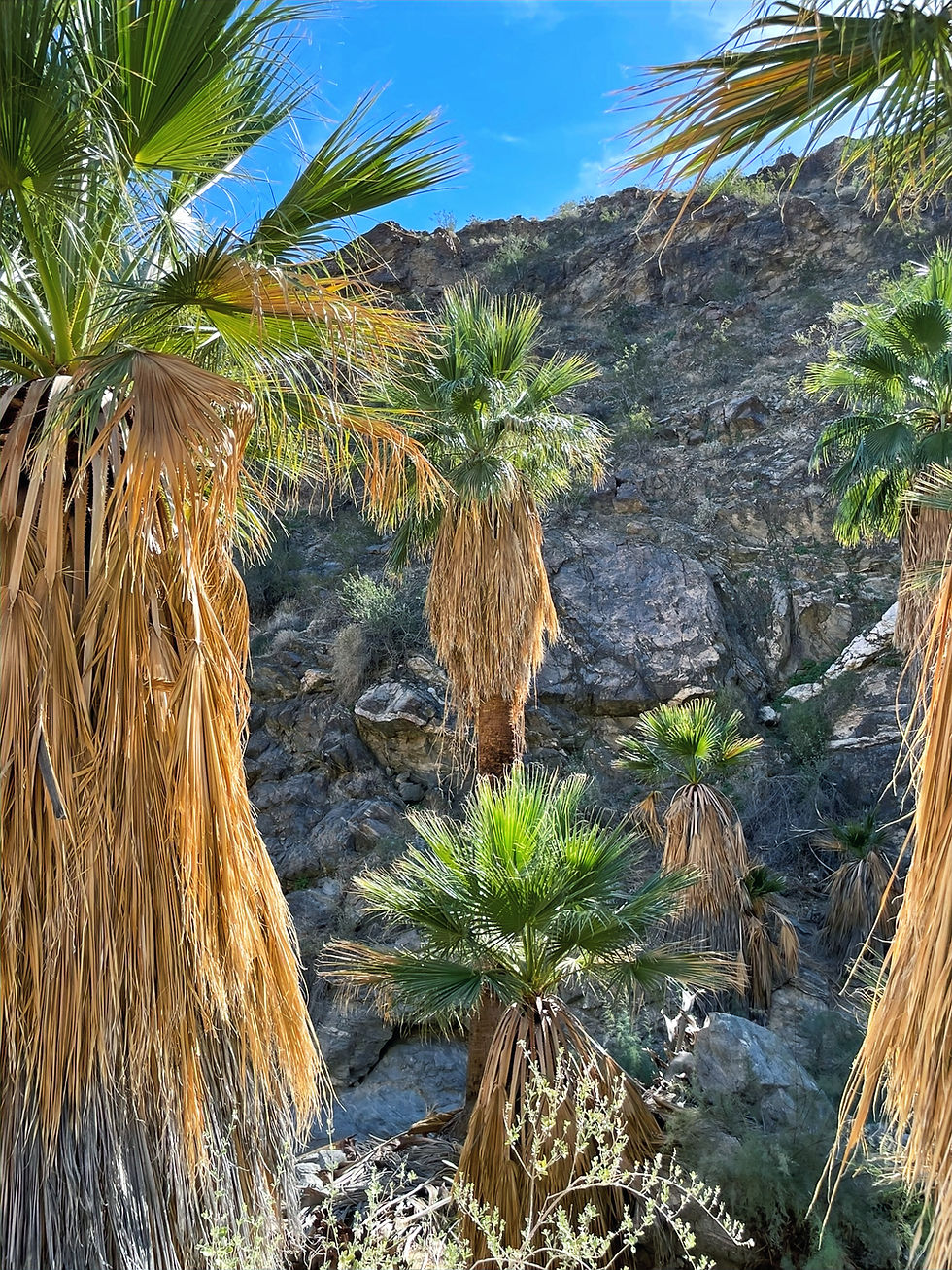
Although Jane Hoffbrau Palm Oasis isn't as expansive as well-known groves like Willis Palms or Palm Canyon, the palms here are surprisingly healthy and abundant. Nestled within the narrow canyon, the oasis feels intimate and secluded, offering a quieter experience than the larger palm groves found elsewhere in the Coachella Valley. It's a reminder that an oasis doesn't have to be large to be ecologically significant.

Unlike Willis Palms or Palm Canyon, Eagle Canyon has only a small watershed and cannot rely on large volumes of runoff from the surrounding mountains. Instead, this oasis depends much more heavily on fractures in the underlying bedrock that collect and direct groundwater toward the canyon. It's a perfect example that the size of a desert fan palm oasis isn't determined by the number of palms, but by the unique geological conditions that allow groundwater to reach the surface.

Read the Landscape
The small seep trickling from a fracture in the canyon wall is one of the clearest clues that groundwater is close to the surface. Even when water isn't flowing, dark-stained rock, lush patches of vegetation, mosses, or mineral deposits often reveal where groundwater is slowly escaping through fractures in the bedrock.
These subtle signs explain why California fan palms are growing here. Their roots don't reach deep underground aquifers; instead, they depend on groundwater remaining close enough to the surface for their roots to access. Once you learn to recognize these clues, you'll begin spotting hidden water sources in desert canyons long before you see the palms themselves.
It's no surprise that we found honey bees gathering near the seep and common side-blotched lizards basking nearby. The groundwater emerging from fractures in the bedrock doesn't just sustain California fan palms; it creates an entire ecosystem. Water supports flowering plants, which attract pollinators and other insects. Those insects, in turn, provide food for reptiles and birds. What begins as groundwater moving through fractured rock ultimately supports a surprisingly rich web of life.
Honey bee drinking from water seep in Eagle Canyon and Jane Hoffbrau Palm Oasis
Having explored many of Southern California's desert fan palm oases, we're always looking for something we've never seen before. At Eagle Canyon, it was this California fan palm growing directly from a fracture in the canyon wall beside a small seep. It was the clearest evidence on the hike that groundwater emerging from fractured bedrock isn't just sustaining the oasis below; it's creating opportunities for life wherever enough moisture reaches the surface.

Read the Landscape
Before we spotted the seep, the landscape was already giving us clues. Dense vegetation clinging to the canyon wall suggested moisture was reaching the surface. Moments later, a small seep emerging from a fracture confirmed it. When hiking desert canyons, look for these signs:
Dense patches of unusually green vegetation
Water seeping from fractures or canyon walls.
Dark staining on otherwise dry rock
Mosses or other moisture-loving plants
California fan palms growing where the surrounding landscape appears barren.
These subtle clues often reveal groundwater long before you see flowing water. Once you learn to recognize them, you'll begin reading the hidden plumbing of the desert.

One of the easiest ways to judge the health of a palm oasis is to look for juvenile palms. Unlike mature trees that may have survived decades of changing conditions, young palms indicate that groundwater has remained reliable enough in recent years for new seedlings to establish and grow. Seeing numerous juvenile palms throughout Jane Hoffbrau Oasis suggested this ecosystem is healthy and actively renewing itself.

Where the Palms Suddenly End
As we continued down the canyon, something unexpected caught our attention. The palms ended almost as abruptly as they began, creating an invisible boundary. The reason wasn't climate or elevation; it was geology. California fan palms can survive only where groundwater remains close enough to the surface for their roots to reach it. Beyond that point, the groundwater drops deeper underground, and the palms disappear. Looking back, we realized we weren't just seeing the end of the grove; we were seeing the edge of the hidden groundwater system.

Don't let the palms be your turnaround point. Continue farther into the canyon, where exposed rock walls reveal the geology that shaped the landscape and created the hidden groundwater system supporting the oasis.

Eagle Canyon feels like it's in the wrong place. Most of us expect dramatic canyons to begin high in the mountains, where streams have miles to carve their way downhill. Instead, this deep gash opens almost at the edge of the Coachella Valley, only a short distance from the desert floor. It seems almost out of place.

The explanation lies in how the Santa Rosa Mountains are still being uplifted. Along this part of the mountain front, uplift is rapid, the slopes are exceptionally steep, and the bedrock is heavily fractured. During flash floods, rushing water exploits those fractures and quickly erodes the weakened rock. Rather than waiting to carve a canyon higher in the mountains, erosion went to work where gravity and geology gave it the greatest advantage.

After 45 minutes exploring the oasis, it was time to begin the climb back to the foothills. But we weren't leaving with the same perspective we had when we arrived. What first looked like a desert canyon had become a landscape full of clues: fractured bedrock, hidden groundwater, seeps, and healthy palms. All these elements tell the story of how geology creates life in the desert.
Protecting a Small Desert Oasis
Jane Hoffbrau Palm Oasis demonstrates that even a relatively small spring-fed oasis can support a healthy and thriving ecosystem. Unlike larger palm groves that draw visitors from around the world, smaller oases are often overlooked, making them especially vulnerable to unintended impacts.
Stay on established trails to protect fragile vegetation and avoid climbing on the seep or surrounding rock fractures where groundwater reaches the surface. Even small disturbances can damage the delicate habitats that support insects, reptiles, birds, and young California fan palms. By leaving the oasis exactly as you found it, you help preserve one of Palm Springs' quieter natural treasures for future visitors.
Back to the Plateau
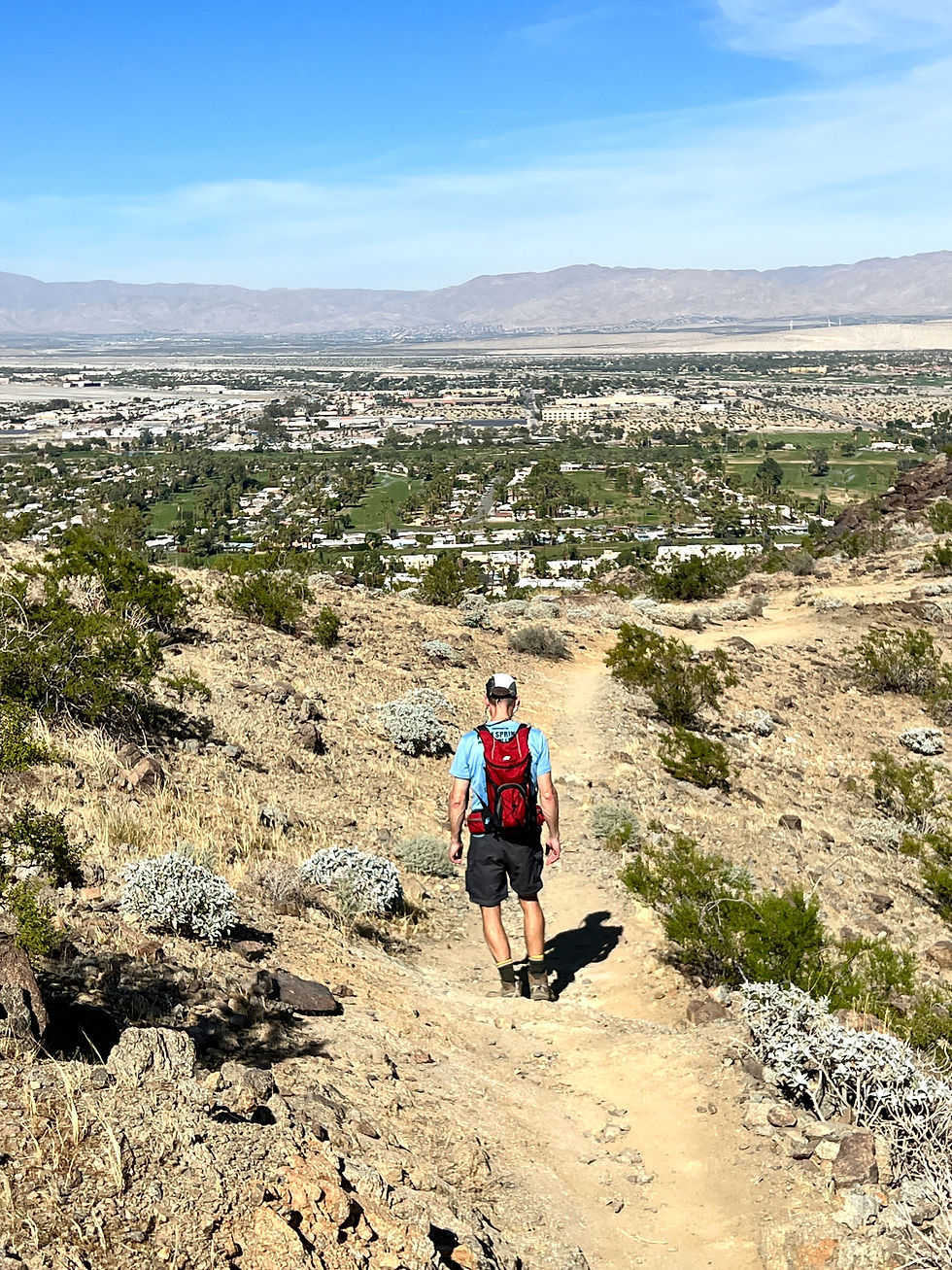
After climbing out of the canyon, the shift is immediate. The rustling of palm fronds in the breeze and the cool shade provided by the canyon walls give way to the noise of hiking boots scuffing against the hard-packed earth and the heat rising from the desert floor.

It's a fast downhill hike back to the trailhead and the end of a great day of hiking.
Closing Thoughts
Eagle Canyon and Jane Hoffbrau Palm Oasis prove that memorable desert hikes don't have to be long or strenuous. In less than four miles, the trail climbs from the open foothills into a quiet canyon where towering California fan palms thrive in a landscape that seems far too dry to support them.
Once you understand why Jane Hoffbrau Palm Oasis exists, it's difficult to look at any desert canyon the same way again. What once appeared to be an ordinary stand of palms becomes evidence of hidden groundwater, fractured bedrock, and an active landscape still being shaped today. That's the real reward of this hike is not simply reaching the oasis, but learning how to read the story written into the landscape.
Continue Exploring the Desert Fan Palm Oasis Series
New to California's desert fan palm oases? Learn how these remarkable ecosystems form, discover their unique ecology, and explore more of the state's finest oasis hikes in California Desert Fan Palm Oases: The Complete Guide.
Looking for your next adventure? Browse Best Desert Fan Palm Oasis Hikes in Southern California to compare the region's most spectacular oasis trails and find the one that's right for you.
Continue Reading the Landscape
Ready for another hike that tells a different geological story? The Araby Trail climbs high above Palm Springs, where sweeping valley views, rugged mountain slopes, and exposed desert geology reveal how dramatically the landscape changes in just a few miles.
051123


