Twisted Canyon Hike: Exploring the Tortured Landscape of the Mecca Hills
Updated: Jun 24
Hike Overview
Location: Mecca Hills Wilderness
Trail Type: Out and Back
Distance: 4.5 miles; shorter version: 2.3 miles
Elevation Gain: 403 ft; shorter version: 250 ft
Difficulty: Moderate or Easy for the shorter version
Terrain/Obstacles: No significant terrain issues or obstacles
Hike Breakdown: Hike is suitable for a novice hiker who wants a challenge
Best Time: October - April
Highlights: Folded sedimentary layers, narrow passageways, and towering canyon walls
TrailsNH Hiking Difficulty Calculator: 60; shorter version: 34

Click here to navigate to the TrailsNH website for a description of the hiking difficulty calculator.
Here is the satellite image of the shorter version of the hike.

Why Hike Twisted Canyon
I refer to this hiking route as "Twisted Canyon" for the way the terrain constantly changes as you move through it. Broad sandy washes give way to narrow passages, while canyon walls bend and twist unexpectedly around every corner. Unlike Ladder Canyon, where the route is defined by ladders and narrow passages, Twisted Canyon is more about exploration, following washes and side canyons as the Mecca Hills gradually reveal themselves.
That ever-changing terrain is also what makes the route so fascinating. At first glance, the Mecca Hills appear chaotic, a maze of ridges, canyons, and rock layers bent into sharp angles. Yet as the hike unfolds, patterns begin to emerge. The winding washes, fractured hillsides, and twisted rock layers all tell parts of the same story, revealing the forces that have shaped this region over millions of years. Understanding those clues transforms the hike from a simple canyon adventure into a deeper appreciation of how the Mecca Hills came to be.
A Landscape Framed by Faults
The first clue appears before the hike even begins. Twisted Canyon (trailhead circled in blue) lies within a complex network of faults that helped shape the Mecca Hills. As shown on the map below, the trailhead sits directly on and between several named fault strands associated with the broader San Andreas Fault system.

Being positioned between faults doesn't mean you'll spend the hike walking directly on fault lines. Instead, you'll be traveling through a landscape that has been fractured, uplifted, and reshaped by their movement over millions of years. The effects appear throughout the route—in the broad washes that cut through the hills, the fractured canyon walls, and the twisted rock layers that give this hike its name.
Let's Start Hiking Twisted Canyon
The hike begins in the broad sandy expanse of Box Canyon Wash (coordinates: 33°35'25.8"N 115°58'23.2"W), where the scale of the landscape is immediately apparent. Stretching far beyond the trailhead in both directions, the wash forms a wide corridor between the rugged ridges of the Mecca Hills. At first glance, it may seem difficult to imagine that the narrow passages and twisting canyons ahead are connected to such an open landscape.

The images below show the width of Box Canyon Wash near the trailhead. Seasonal floods have repeatedly swept through this corridor, carrying sediment downstream and helping shape the broad sandy floor seen today. Yet water is only part of the story. As the hike leaves the main wash and enters the side canyons, clues begin to appear that reveal why this landscape is far more complex than it first appears.
Smoke Trees of the Wash
One clue to the power of water in Box Canyon Wash can be found growing along its sandy floor. Smoke trees occur in washes throughout the desert, where periodic flash floods help create the conditions needed for these trees to establish. Floodwaters scarify their hard seed coats, allowing moisture to penetrate and trigger germination. The result is a landscape where young seedlings, mature trees, and weathered veterans grow side by side, each reflecting a different chapter in the wash's history.
Juvenile smoke trees, many less than 6–8 inches tall, are taking root in the sandy sediments of Box Canyon Wash. Hundreds of seedlings stretch across portions of the wash, hinting at how dramatically the landscape could change if enough survive to maturity. Their abundance serves as a reminder that periodic floods continue to shape the Mecca Hills and this canyon.

Even young smoke trees are remarkably adapted to desert life. Instead of relying on leaves, their gray-green branches carry out photosynthesis directly, helping reduce water loss in the arid environment. Beneath the surface, nitrogen-fixing bacteria living in their roots allow the trees to thrive in the nutrient-poor sands and gravels of Box Canyon Wash. Together, these adaptations help smoke trees establish themselves in one of the harshest environments in North America.

Further along the wash, mature smoke trees demonstrate what successful survival in the desert looks like. Their flexible branches withstand the force of floodwaters, while extensive root systems allow them to take advantage of moisture whenever it becomes available. Some taproots may reach depths of 20-60 feet, helping the trees endure long periods of drought. At the same time, shallow feeder roots near the surface quickly absorb water from brief rainstorms and flood events. Together, these adaptations allow smoke trees to thrive in an environment shaped by both scarcity and sudden abundance of water.

Entering the Heart of the Mecca Hills
Crossing Box Canyon Wash feels like stepping into a different landscape. The route leaves the expansive floodplain behind and enters the deformed core of the Mecca Hills, where faulting, uplift, and erosion have created a maze of ridges and canyons.

Although the wash is dry right now, that's not always the case. Rainstorms, although rare, bring sheet flow as water pours off the nearby hills and drains into the wash. Very little of the fast-moving runoff penetrates the dense, compacted sand of the wash. In order to survive, desert shrubs like this sweetbush produce lateral shallow roots that are able to capture significant amounts of fast-moving runoff.

The vegetation also provides clues about how water moves through the wash. Creosote and brittlebush often grow along the margins, where runoff slows and has more time to soak into the soil. These areas receive less of the destructive force of floodwaters while still benefiting from the moisture they leave behind. Even the appearance of the plants can reveal recent conditions. Healthy creosote bushes with deep green foliage often indicate adequate moisture, while curled or discolored leaves may signal prolonged dry conditions.

The influence of water becomes even more apparent when comparing nearby plants. Just a few feet from the healthy creosote, a severely dehydrated beavertail cactus and a drought-stressed Mecca aster struggle to survive. The contrast highlights how unevenly moisture is distributed across the desert landscape. Even species well adapted to drought depend on occasional rainfall and runoff, and prolonged dry periods can push those adaptations to their limits.
Water shapes life in the wash, but it can also bring destruction. Over time, floodwaters have stripped away several feet of sediment around this tree, leaving much of its root system exposed above the canyon floor. Without the protection of surrounding soil, roots become vulnerable to drying, extreme heat, and physical damage during future flood events. Eventually, the tree could no longer survive. Its exposed roots serve as a reminder that the same forces sustaining life in Mecca Hills washes are also constantly reshaping it.

When the Canyon Walls Start to Close In
After a little more than half a mile, the route leaves the main drainage and enters a smaller canyon branching off to the right. The landscape begins to change as the wide wash narrows and the surrounding hills close in.

Almost immediately, the canyon splits again. A narrow passage branches to the right while a wider canyon continues straight ahead. We chose to explore the narrow canyon first.

These steep canyon walls provide increasing amounts of shade, reducing evaporation and allowing moisture to linger longer after rain events. The result is a slightly cooler, more sheltered environment than the exposed, wide-open wash. This topography creates a small desert microclimate.

Mecca Asters in a Canyon Still Under Construction
As the canyon walls close in, a plant unique to the Mecca Hills starts to appear. The Mecca aster is endemic to this region, growing nowhere else on Earth. During our visit, the plants were lush with foliage but carried only a few remnants of last season's blooms.
Mecca asters thrive in the fine sands and silts found along wash margins and eroded canyon slopes, where moisture lingers longer after rain events. They typically occur in small clusters scattered throughout the landscape rather than forming large stands. For much of the year, their gray-green foliage blends into the surrounding desert, making them easy to overlook.

Mecca asters depend on meaningful late-winter and early-spring rainfall to produce their blooms. Spotting a bloom is always a highlight during our hikes, and we encourage everyone to take a moment to appreciate these small bursts of color when they appear. With a limited range and a dependence on seasonal rainfall, the future of this endemic desert plant is closely tied to the changing conditions of the Mecca Hills.

The smooth sandy floor of the narrowing canyon provides evidence that water still moves through this passage during storms. As runoff is funneled into an increasingly confined corridor, its erosive power becomes concentrated, allowing it to cut downward into the canyon floor rather than spread across a broader wash. Over time, this process deepens the channel and helps create the narrow, slot-like sections found farther upstream.
The image below reveals several clues that this process is still underway. The area circled in orange marks a patch of more strongly cemented sediment that resists erosion. During storms, water is diverted around these tougher zones, concentrating its energy on the softer sediments and deepening the channel rather than widening it.
Additional evidence can be seen in the loose debris scattered along the base of the canyon walls. As floodwaters gradually remove material from the lower slopes, sections of the canyon wall become unstable and collapse into the wash. Future floods then carry away the fallen debris, continuing the process of canyon development.

A Hidden Sign of Life: Big-Jawed Termite Tubes
One of the benefits of slowing down and looking closely is discovering details that are easy to overlook. During our pre-hike exploration, we noticed several big-jawed termite tubes at the base of desert plants. This hidden layer of activity beneath the surface of the canyon had been overlooked on several previous hikes.

What are these tubes? They are protective foraging sleeves constructed from a type of termite cement composed of soil, saliva, and fecal material. Termites create these mud tubes to shield themselves from predators like lizards and birds while moving and foraging above ground. Without an exoskeleton, termites are highly vulnerable to drying out; the tubes also help maintain moisture and protect them from the scorching sun.

Worker termites construct these narrow tubes that extend from the nest to the surrounding vegetation. As they forage, the tubes are expanded around individual stems, allowing the termites to remain protected while moving above ground. Despite building on living plants, big-jawed termites generally do not harm healthy vegetation. Rather, they consume dead and decaying organic material. From this photo courtesy of iNaturalist, it's easy to see how these insects earned their common name.

F
When the Canyon Tightens to a Dead End
With the termite tubes examined, we continued deeper into the canyon. The passage narrowed further, and the effects of erosion became increasingly difficult to ignore. Although this canyon is relatively short, its steep walls and occasional constrictions reveal a landscape still being actively shaped by floodwaters.

It wasn't long before the canyon came to an end. The passage narrowed into a slot-like opening, but sand and debris blocked the route beyond, forcing us to turn around.
The Second Canyon: Towering Walls and a Widening Floor
What makes this hike especially enjoyable is that the hike doesn't end at the first canyon. After returning to the junction, we continued into the second canyon, where the landscape quickly takes on a different character.

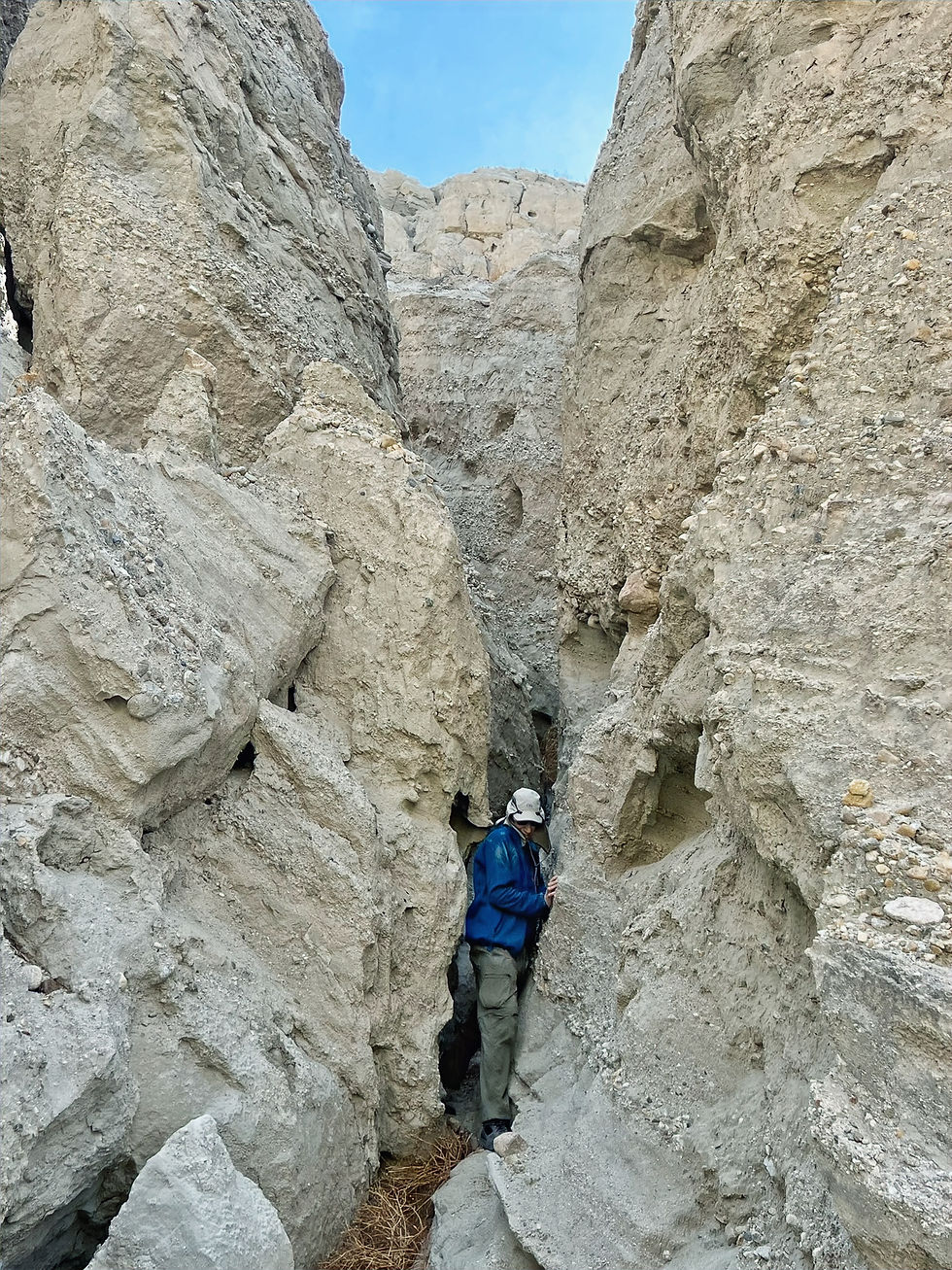
As we approached this narrow opening, the canyon walls began rising dramatically.

What is now an opening between towering walls was once part of a continuous rock mass before countless flood events gradually widened fractures and weaknesses in the rock. Today, the remaining walls stand as a reminder that the canyon is still being shaped by the same processes that created it.

Why the Canyon Opens Up
After passing through the narrower entrance, the character of the canyon changes once again. The walls pull farther apart, and the canyon floor becomes noticeably wider. This shift reflects a change in how floodwaters are eroding the landscape.
When flash floods move through canyons like this, the water carries large amounts of sand, cobbles, and boulders. This sediment-laden flow acts like a natural abrasive, grinding and scouring the canyon as it moves downstream through the softer sedimentary rock.
Whether a canyon becomes deeper or wider depends on where the floodwaters concentrate their energy. If the canyon floor contains resistant layers or accumulations of cobbles and boulders, downward erosion becomes less efficient. In those areas, the force of the water is redirected toward the canyon walls, gradually widening the passage. The broader canyon floor seen here is one result of that process.

Not all canyon widening happens grain by grain. In places where the walls are made of soft sediments and loose sand, entire sections can collapse into the wash during storms. These slope failures, known as mass wasting, allow the canyon to widen in sudden bursts rather than through slow, continuous erosion.

This section of canyon wall provides another example of erosion at work. Notice the horizontal ledge above Dave's head. This more resistant layer has eroded more slowly than the softer sediments surrounding it, creating an overhang through differential erosion. As floods continue to remove material from beneath the ledge, the unsupported rock becomes increasingly unstable. Eventually, sections collapse into the wash, as evidenced by the large boulders scattered below. Over time, these periodic failures contribute to the gradual widening of the canyon.

As we continued through the canyon, it became clear that widening is not driven by a single process. Floodwaters act as a natural abrasive, grinding away at the rock during each storm. Undercutting weakens canyon walls from below, while periodic collapses remove large sections of unstable slopes. Together, these forces are steadily reshaping the canyon, one flood, one collapse, and one storm season at a time.

Uplift and Folding
While erosion is responsible for carving many of the canyons and washes seen throughout the Mecca Hills, it does not explain why so many rock layers are tilted at steep angles. The answer lies in the uplift and deformation that accompany movement along the San Andreas Fault system.
The photograph below provides a clear example. The yellow line highlights a sedimentary bedding plane that was originally deposited as a nearly horizontal layer. Today, it sits at an angle exceeding 30 degrees, evidence that the rocks have been uplifted and tilted since they were deposited.
Research suggests that portions of the Mecca Hills have experienced thousands of feet of uplift over the last several million years. As the landscape rose, runoff from the surrounding mountains became more energetic, accelerating erosion and helping carve the maze of washes and canyons explored on this hike.

Small Discoveries in a Big Landscape
pre-hike
During one of our pre-hikes, Susan and Ada spotted these spider webs stretched across pencil-sized openings in the canyon wall. The arrangement appears to create an effective ambush point, with the opening potentially attracting curious insects that become trapped in the surrounding web. Although we were unable to identify either the spider or the creator of the original hole, it was one of those small discoveries that many hikers would likely walk right past.
Not to be outdone, Dave and I found an abandoned hummingbird nest tucked several feet above the ground in a creosote bush. Built from plant fibers and lichen bound together with spider silk, the nest is both strong and flexible. Its concealed location helps protect hatchlings from predators.

Why This Slot Canyon Narrows and Twists: A Geologic Shift
The second canyon constantly changes character. Broad sections of wash are interrupted by surprisingly narrow passages where the walls close in and ....

.... briefly becomes slot-like. These abrupt transitions are not random; they reflect changes in the composition of the sedimentary rock and how erosion responds to those differences.

Why These Walls Still Stand
The trail actually continued through this narrow crevice, raising the question: why haven't these walls collapsed? Despite their thin appearance and the constant forces of erosion acting upon them, several factors help these rock fins remain standing.
Cementation
Some portions of the sedimentary layers have been more tightly bound together by minerals through a process known as cementation. Where cementation is strong, the rock becomes more resistant to erosion. Where it is weaker, water is able to remove material more rapidly, carving deeper into the canyon walls.

Large Clasts
Mixed throughout the sediments are pebbles and small cobbles known as clasts. In some locations, these coarse fragments act much like aggregate in concrete, helping reinforce the surrounding sediment. Areas with a higher concentration of clasts tend to erode more slowly than the finer-grained material around them.
Together, variations in cementation and clast concentration create differences in rock strength. These differences drive differential erosion, helping shape the winding passages, narrow squeezes, and unusual rock forms encountered throughout Twisted Canyon.

Why the Twisted Canyon Walls Are Twisted
One of the most striking features of the narrow passageways is the wavy pattern carved into the canyon walls. These curves form because the sediments do not all erode at the same rate. Smoother sandy layers are worn away more easily, while pebble-rich zones and better-cemented sediments offer greater resistance.

As floodwaters encounter a resistant patch, the flow is diverted around it and concentrates its energy on adjacent softer material. With each storm, these small deflections become more pronounced as the water repeatedly follows the path of least resistance. Over time, the process creates a series of curves and undulations, producing the canyon walls seen throughout Twisted Canyon.

Heading Back
We followed the canyon for roughly 1.5 miles as it alternately widened and narrowed, revealing new twists and features around nearly every bend. Eventually, we decided it was time to turn around and begin the hike back to the trailhead.

By the time we returned, the sun was low on the horizon, casting a warm golden light across the canyon walls and surrounding hills.

Final Thoughts from the Trail
Twisted Canyon feels like discovering a quieter side of the Mecca Hills—less visited than Ladder Canyon and Painted Canyon, yet every bit as rewarding. The alternating washes, narrow passages, and towering canyon walls create a landscape that constantly changes as you move through it.
Before leaving, take one final look at the canyon around you. The walls are still being shaped by the same forces that created them. Flash floods continue to deepen channels, widen sidewalls, and expose new layers of sediment with each passing storm. Here in the Mecca Hills, the landscape is not frozen in time; it is still evolving.
SPECIAL NOTE: This was the first time Dave had led a Friends of the Desert Mountains Guided Interpretive Hike, and he did an incredible job.

If this hike leaves you looking more closely at the rocks, plants, and hidden details around you, you're not alone. The desert rewards that kind of attention, revealing discoveries to those willing to slow down and explore. For more geology-focused adventures in the Mecca Hills, be sure to explore our guides to Skeleton Canyon and The Grotto Trail.
Skeleton Canyon

Explore one of the most geologically diverse canyons in the Mecca Hills, where faulting, erosion, and colorful sedimentary layers reveal the forces shaping the landscape.
The Grotto Trail

Follow a winding canyon to one of the Mecca Hills' most unusual hidden features—a natural rock chamber carved into the heart of the hills.
310125


