Hike Vargas Palms Oasis: A Hidden Gem at the Base of the San Jacinto Mountains
Updated: Jul 19
Hike Details
Location: Snow Creek Canyon in the foothills of the San Jacinto Mountains
Trail Type: Loop
Distance: 5.05 miles
Elevation Gain: 567 feet
Difficulty: Moderate
Terrain/Obstacles: Several potential water crossings, sandy wash environment, Class 2 boulder scrambling. No established/marked trail.
Hike Breakdown: Hike is suitable for novice hikers who want a challenge
Best Time: October - May
Highlights: Hiking San Jacinto foothills, secluded palm oasis, water crossings

TrailsNH Hiking Difficulty Calculator: 76 – Moderate
Click here to navigate to the TrailsNH website for a description of the hiking difficulty calculator.
Here is a satellite view of the Vargas Palms Trail with mile markers included.

Why Vargas Palms Is Worth Visiting
Vargas Palms isn’t the largest desert fan palm oasis, nor is it the easiest to reach. What makes it special is its setting. Nestled against the towering San Jacinto Mountains, it reveals how faults, snowmelt, floods, wildfire, and groundwater combine to create a small refuge in one of California’s beautiful mountain ranges. The journey is as much about understanding the forces that shaped this rugged canyon as it is about reaching the palms themselves.
Know Before You Go
Snow Creek and the surrounding boulder field provide ideal habitat for rattlesnakes. They are most active from spring through fall and may be encountered along the trail, in sandy washes, or resting among the granite boulders. Stay alert, watch where you place your hands and feet, and always give snakes plenty of space.

Let’s Start Hiking
At first glance, the trailhead doesn't look like the beginning of a typical desert hike. Fresh snow blanketed the towering San Jacinto and San Bernardino Mountains, creating one of those rare landscapes where the desert meets the alpine world.

A series of atmospheric rivers had recently blanketed the San Jacinto and San Bernardino Mountains with deep snow, creating a striking contrast with the desert below. Unfortunately for us, a storm had swept across Southern California just days before our hike, bringing even more rain and snow to the region.
Since it was our first visit to this area, the Road Closed sign about a mile before the trailhead didn't seem especially concerning. We assumed it reflected minor storm damage rather than a major change to the trail.

Because the trail begins in the broad Snow Creek Wash where it crosses Snow Creek Road, we parked the car and planned to add the extra mile to our hike.

Recent mudflows from the San Gorgonio River blocked the usual route, so we headed east toward its confluence with Snow Creek, hoping to find a better crossing. Within minutes, it became clear that the winter storms had dramatically reshaped the wash. Fresh sheets of dark mud covered the normally pale sandy wash.

Multiple channels of flowing water now cut across the floodplain, making what is usually an easy walk into a route-finding challenge. Every path seemed to end at another stream, and we continually adjusted our path in search of a shallow crossing. Looking downstream, the San Gorgonio River spread across the valley floor, illustrating just how much water the recent storms had delivered to the desert.

When the Desert Becomes a River
For a brief time each winter, this corner of the desert can be transformed into a river landscape. Snowmelt and storm runoff from the 10,000-foot San Jacinto Mountains combine with the much larger San Gorgonio River. This river drains the towering San Bernardino Mountains, sending torrents of cold, sediment-laden water across the normally dry wash.
Did You Know?
In less than 10 miles, the landscape rises from the Coachella Valley floor, which lies near sea level, to more than 10,800 feet atop San Jacinto Peak. This extraordinary elevation change creates one of the steepest mountain fronts in North America, producing powerful runoff that can rapidly turn Snow Creek and the San Gorgonio River into a single wide, fast-moving river.
Since there is no legal route to Vargas Palms that avoids crossing Snow Creek, we continued along the edge of the wash hoping to find a narrower crossing. Instead, it quickly became apparent that reaching the oasis would require several crossings through cold, fast-moving, calf-deep water.

Although the crossings appeared manageable, we weren’t prepared to spend the rest of the day hiking in soaked boots and socks. With no towels or dry footwear waiting back at the car, we made the sensible decision to turn around and return a few days later after the floodwaters had hopefully receded. Sometimes the best decision on the trail is to come back another day.

How High Did Snow Creek Rise?
While researching this hike, I found several reports from hikers who encountered thigh-deep water during the peak of the storm runoff—a reminder that Snow Creek and the San Gorgonio River should never be underestimated after heavy rain or rapid snowmelt.
Safety Tip
Always check recent weather conditions before hiking to Vargas Palms. Even if skies are clear, runoff from storms or snowmelt high in the San Jacinto Mountains can keep Snow Creek flowing strongly for days.
Most hikers experience Snow Creek as a dry wash or a modest stream crossing. Visiting just days after a series of winter storms offered a rare opportunity to witness the powerful forces that continue to shape this landscape.
Returning to Snow Creek
When we returned a few days later, the river had changed, but the beautiful landscape had not.

While the high water levels had delayed our hike, they are essential to the health of the ecosystem. Seasonal floods transport fresh sediment, recharge groundwater, reshape the wash, and sustain the conditions that allow Vargas Palms to thrive. As the waters recede, they leave behind moisture that nourishes vegetation and, in favorable years, helps produce spectacular wildflower displays.

Spring Wildflowers of the Wash
We begin the hike on a broad alluvial sand terrace built by thousands of years of repeated flooding. Although these terraces lie beside the active wash, they are high enough to avoid the most destructive floods. Their well-drained sandy soils support a distinctive plant community where mature desert shrubs are joined by colorful annual wildflowers.

Vast fields of desert dandelions blanketed the sandy terraces, their bright yellow flowers transforming the muted desert landscape. As opportunistic annuals, they quickly take advantage of the moisture left behind by winter storms, flourishing on the well-drained alluvial soils bordering Snow Creek.

While many desert wildflowers only bloom across open ground, desert dandelions are commonly found around mature shrubs. The shrubs trap windblown seeds, enrich the soil with organic matter, and provide shade that helps seedlings survive in the harsh desert environment.

The few areas not blanketed by desert dandelions were carpeted with Wallace’s woolly daisy, transforming the terraces into an almost unbroken display of yellow wildflowers.

Though small in stature, Wallace’s woolly daisy is perfectly adapted to life in the desert. The dense, woolly hairs covering its leaves and stems trap moisture from morning dew while shading the leaf surface to reduce water loss caused by the intense desert sun. It is also one of the first plants to colonize sandy washes and recently disturbed soils, thriving in areas periodically reshaped by flooding before larger shrubs become established.

At first glance, this wild rhubarb appears remarkably lush for a plant growing in the desert. Its secret lies beneath the surface, where a network of thick, fleshy tuberous (tube-like) roots stores water collected during winter rains.

These underground reservoirs allow the plant to quickly produce tall spikes of delicate pink flowers that rise above its blue-green leaves. As the flowers fade, they transform into papery, rose-colored seed pods.

One of the highlights of the hike was discovering a patch of Coachella Valley milkvetch quietly growing on the sandy terrace.

Coachella Valley milkvetch is one of the rarest wildflowers in California, found naturally only in a small portion of the Coachella Valley. In spring, it produces clusters of vibrant purple, pea-like flowers. Like other members of the pea family, it helps enrich the soil by fixing nitrogen, allowing it to thrive in nutrient-poor desert environments. Spotting this federally endangered plant is a reminder that even the harshest landscapes support species found nowhere else on Earth.

Crossing Snow Creek at Last
We could have spent hours admiring the remarkable diversity and abundance of wildflowers, but Snow Creek was waiting. What a difference a few days can make. The torrent that had forced us to turn back on our first visit had retreated into a well-defined channel, making the crossing straightforward.
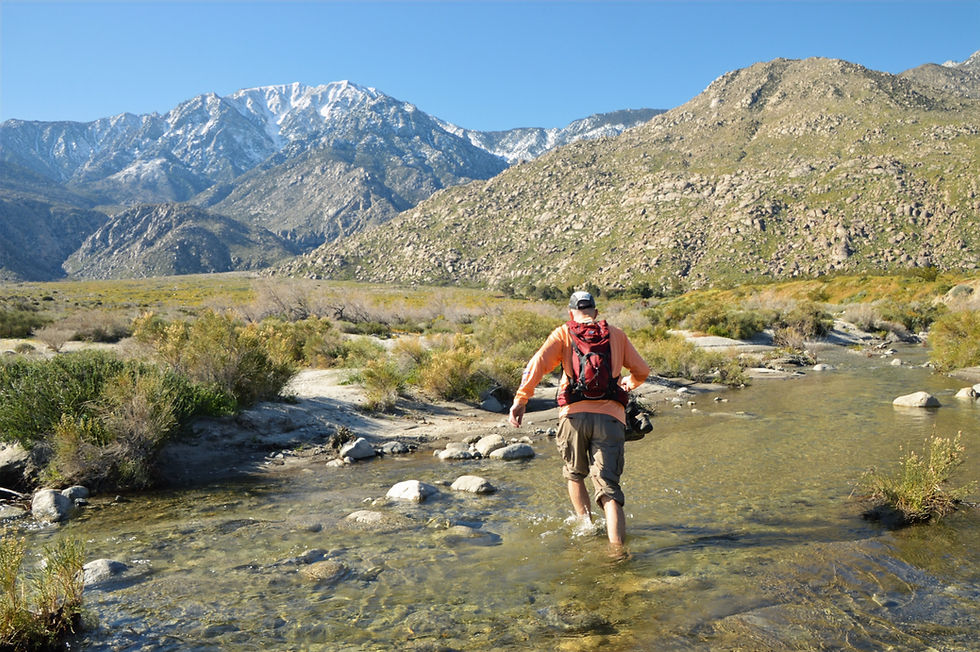
As we stepped into the crystal-clear water, it was hard to believe that only days or weeks earlier it had been snow high on the mountain slopes.

Now that same snowmelt flowed quietly through the desert, continuing its journey toward the valley below.

Crossing Snow Creek also meant crossing into a different plant community. The stable shrubs of the sandy terraces gave way to the active floodplain, where shifting sands are dominated by a handful of highly specialized plants. One of the most striking was sand verbena. Its sprawling stems spread across the loose sand, anchoring the plant in an environment that is constantly reshaped by flowing water and wind.

Dense clusters of brilliant magenta flowers stood out against the pale sands of the floodplain. Softly hairy leaves helped reduce water loss, allowing the plant to thrive in this arid desert environment.

Alongside the vibrant magenta blooms of sand verbena, the tiny flowers of Parry's sand blossoms formed carpets across the open sand. Unlike many of the other wildflowers along the trail, their five-petaled flowers vary in color from white to pale lavender and soft purple.

A true sand specialist, Parry's sand blossoms thrive in loose, windblown sand and recently deposited flood sediments where few other plants can gain a foothold. Their shallow root systems and rapid life cycle allow them to take advantage of the brief window of moisture following winter rains by blooming, setting seed, and completing their life cycle before the intense heat of summer arrives.

It seemed that every open space between the established shrubs was filled with desert dandelions. Wherever sunlight reached the sandy ground, thousands of bright yellow flowers transformed the terrace into a yellow carpet.

Among the spring wildflowers stood clusters of Engelmann's hedgehog cactus, its dense covering of spines offering a sharp contrast to the delicate annual blooms surrounding it. In late spring, these cacti produce spectacular magenta flowers, but for most of the year they rely on a very different strategy for survival. Thick, water-storing stems and formidable spines help protect them from thirsty animals while conserving precious moisture through years of drought.

Unlike many desert shrubs and cacti that protect themselves with thorns, spines, or tough, resin-coated leaves, most of Snow Creek's spring wildflowers rely on a different strategy. They grow rapidly after winter rains, bloom for just a few weeks, and produce thousands of seeds before the summer heat arrives. Their survival depends not on physical defenses, but on timing, abundance, and the moisture provided by winter rains and cool temperatures.

Entering the Boulder Field
The wildflower-filled floodplain eventually gave way to a landscape shaped less by seasonal floods and more by the weathering of the surrounding mountains. As we continued up canyon, scattered granite boulders grew progressively larger.

There is no well-defined trail through the boulder field. Instead, the route becomes an exercise in choosing the easiest line between the massive granite blocks.

There are numerous approaches to the oasis, and while each route is slightly different, none requires technical scrambling.

Although our route remained easy to navigate, weaving between these giants added a new sense of adventure to this oasis hike. It's impossible not to wonder how so many enormous boulders had come to rest in a single canyon.

The answer lies in millions of years of weathering. Fractures within the granite slowly widened as temperatures fluctuated and water seeped into the cracks. Eventually, these conditions caused massive blocks to break free from the steep slopes of the San Jacinto Mountains.
Rather than tumbling all the way to the canyon floor in a single event, these house-sized boulders gradually creep downslope over thousands of years under the force of gravity. Together with erosion and occasional flash floods that redistributed smaller rocks and sediment, these slow but persistent processes create the spectacular boulder field that now forms a dramatic gateway to Vargas Palms.

A view of Vargas Palms Oasis was more than enough encouragement to continue.

After working through the main boulder field, the terrain briefly opens onto a flatter section where the palms suddenly come into full view. However, one final cluster of large granite boulders still guards the entrance to the oasis.

None of the moves are technical or especially difficult, but the final scramble adds just enough adventure to make arriving beneath the palms feel well-earned.

Reaching Vargas Palms Oasis
The final scramble over the granite boulders marks the end of the hike's most rugged section. Beyond the last rocks, the palms rise above a gentler, boulder-strewn slope where the oasis has taken root.

Time for lunch and appreciating these views

A Small but Intimate Oasis
Unlike the expansive palm groves at Pushawalla or Willis Palms, Vargas Palms occupies a much smaller pocket within Snow Creek Canyon. A dependable supply of groundwater supports a healthy stand of California fan palms, but the steep granite slopes and extensive boulder field leave only a limited area where new palms can become established. The result is a compact oasis that feels quiet, secluded, and untouched.

Why an Oasis Exists Here
Vargas Palms owes its existence to the towering San Jacinto Mountains. Winter storms and spring snowmelt soak into fractured granite high above the canyon before slowly moving underground. As this groundwater reaches the base of the canyon, it rises close enough to the surface to support California fan palms year-round. Snow Creek's seasonal floods also replenish groundwater and deposit fresh sediment, helping sustain the oasis in one of the driest regions of North America.

An Oasis That Survived Fire
Many of the palms at Vargas Palms still bear the blackened trunks left behind by the 2020 Snow Fire. At first glance, they can appear damaged or dying, but the opposite is true. California fan palms are remarkably well adapted to periodic wildfire. Their growing point is protected high within the crown, allowing new fronds to emerge even after flames have scorched the trunk and consumed dead leaves. The contrast between charred trunks and vibrant green crowns is a reminder that fire has long been a natural part of this mountain desert landscape. Rather than destroying the oasis, the Snow Fire demonstrated the remarkable resilience of one of California's only native palm species.

Life Among the Granite
The oasis occupies a small bench nestled in the foothills. Above it, fractured granite continues up the mountainside, where weathering has produced an endless scatter of boulders of every size. This rugged setting limits the amount of suitable habitat for palms, helping explain why Vargas Palms remains a relatively small oasis compared with the larger groves found elsewhere in the Coachella Valley.

A Different Way Back
Leaving the oasis, we carefully worked our way back through the granite boulders before descending toward Snow Creek.

On the return hike, we chose a different route across the sandy terraces. An old dirt road provided a pleasant alternative for the return hike. The sides of the road were covered in flowering brittlebush, one of the signature flowering perennials of the Sonoran Desert.

Did You Know?
Naturalists often refer to a "signature plant" as a species that defines the character of a landscape. These plants are especially abundant, visually distinctive, or ecologically important, making them among the first things people associate with a particular habitat.

Their nectar-rich flowers attract a variety of native bees and butterflies, while the silvery-gray leaves reflect sunlight and help conserve moisture, adaptations that allow the plant to flourish in the Sonoran Desert environment.

This route also revealed some of the largest displays of Wallace's woolly daisy we had encountered all day.

After our final Snow Creek crossing, the landscape changed once more.

The broad carpets of daisies gave way to sandy banks where brilliant California poppies thrive along the edge of the active channel.

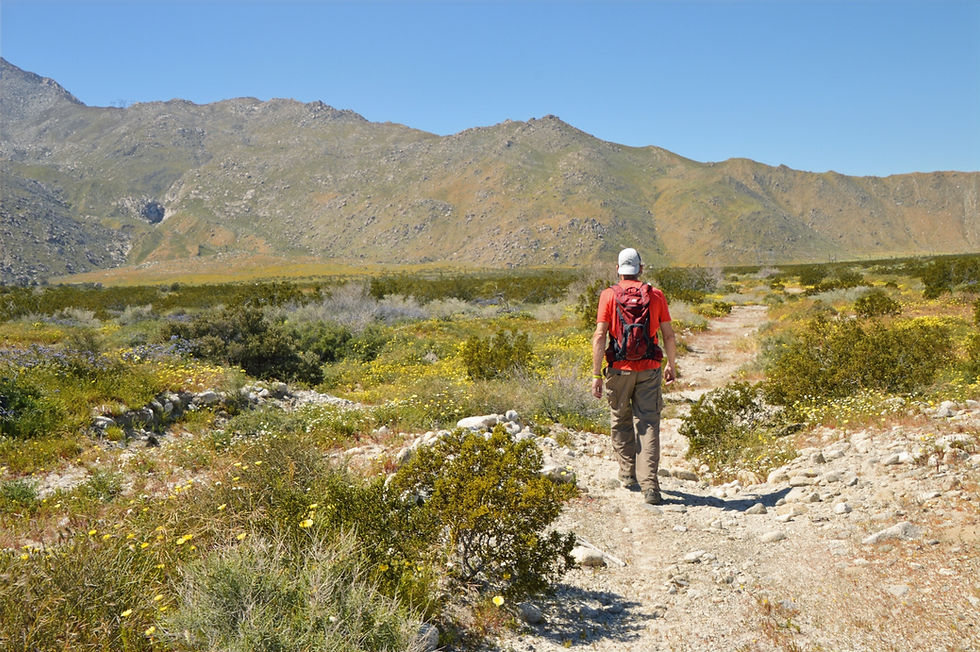
Once back on the terrace, it was an easy walk to the trailhead. The return offered one last chance to enjoy the spring wildflowers and take in the broad view of the San Jacinto Mountains before our hike came to an end.
Final Thoughts
Vargas Palms is unlike any other palm oasis hike in the Coachella Valley. Instead of following a defined trail into a canyon, the route crosses an active floodplain, winds through wildflower-covered sandy terraces, traverses an ever-changing boulder field, and finally reaches a secluded grove of California fan palms tucked against the base of the San Jacinto Mountains.
The experience is shaped by water. Winter storms, spring snowmelt, and occasional summer monsoons continually reshape Snow Creek, creating new channels, depositing fresh sand, and sustaining an oasis that has persisted for thousands of years. If you're comfortable with route finding, stream crossings, and a bit of rock scrambling, Vargas Palms offers one of the most rewarding adventures in the Coachella Valley.
Continue Exploring the Desert Fan Palm Oasis Series
New to California's desert fan palm oases? Learn how these remarkable ecosystems form, discover their unique ecology, and explore more of the state's finest oasis hikes in
Looking for your next adventure? Browse Best Desert Fan Palm Oasis Hikes in Southern California to compare the region's most spectacular oasis trails and find the one that's right for you.

