Beyond the Scenery: Why the Kim Nicol Trail Matters More than Its Views
Updated: Dec 30, 2025
The Kim Nicol trail, nestled in the Indio Hills close to Desert Hot Springs, is located off Corkhill Road in Desert Edge. The terrain is very sandy, at times with thick, soft sand that the lizards love but hikers hate. The hike also has a steep incline, but you will be rewarded with the amazing natural geology of the rocks and, at the top, with 360-degree views of the open desert and the surrounding hills and mountains.
Even though the trail abuts urban and commercial developments, you may not see anyone during this hike - so be prepared. The terrain is sandy, a constant reminder that in many areas you are walking across an active sand dune. So budget extra time if you’re not used to trudging through loose sandy terrain. There is no shade along the trail so plan an early start and bring MORE water than you normally would for a 6+ mile hike.
It's More Than Meets the Eye
If you were to ask Coachella Valley hikers about their favorite trails, chances are you’ll hear names like Art Smith, Pushawalla Palms, or Mecca Wilderness trails. Rarely will anyone recommend the Kim Nicol Trail. This loop nestled in the Indio Hills just outside of Desert Hot Springs doesn’t offer dramatic mountain climbs or slot canyons. At first glance, it’s little more than sand, shrubs, with ribbons of illegal off-road trails through a scrubby desert flat.

But here’s the thing, the Kim Nicol Trail isn’t about overwhelming beauty. It’s about habitat and protecting a rare ‘ecological corridor’ where species cling to survival. For wide-ranging species like coyotes, bobcats, and kit foxes, that corridor is a lifeline. For smaller dune specialists, it’s the last thread of survival. The value of Kim Nicol isn't measured in vistas— it’s measured in what it preserves.
To be honest, on my first visit I went in with the 'where's the big moment on this hike' approach and was not impressed. It was afterwards when I stepped back and researched the conservation and preservation efforts to protect these and the surrounding lands that I began to appreciate this trail. So if you venture here, ignore how it looks in some places and remember you are witnessing conservation in action. It’s not always going to be beautiful.

Hike Distance: 6.13 miles
Elevation Gain: 1,330 feet
TrailsNH Hiking Difficulty Calculator: 128 – Moderately Strenuous but due to the thick soft sand throughout the trail, I'd add an additional 10 points to the Difficulty Score.

Click here to navigate to the TrailsNH website for a description of the hiking difficulty calculator
Let's Start Hiking
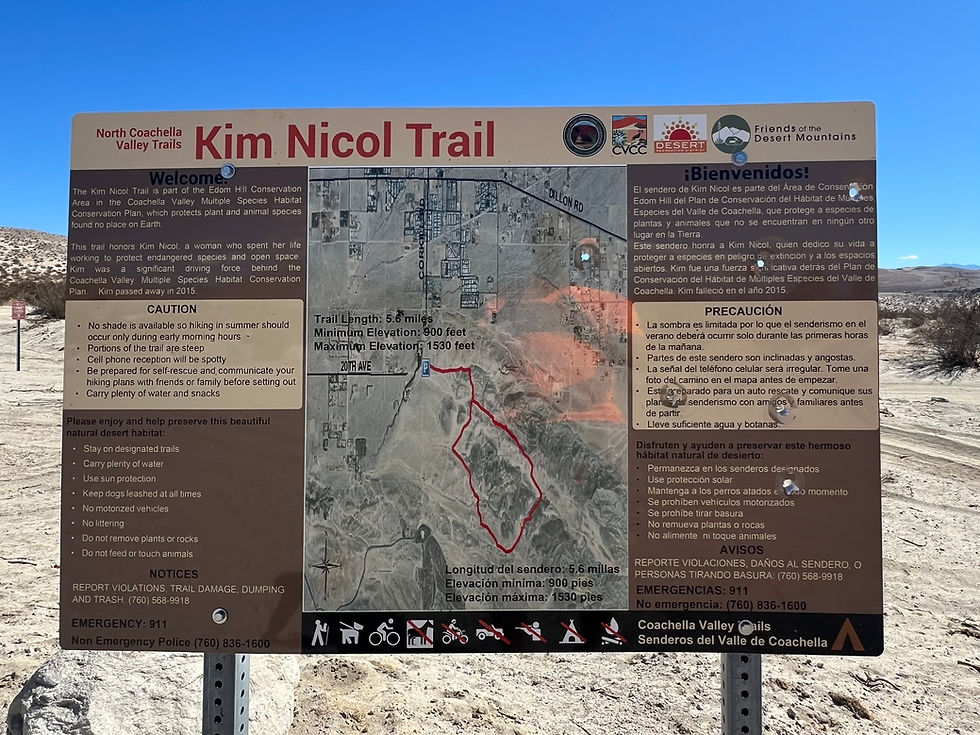
If the Kim Nicol Trail were just an isolated patch of sand, it might be too small to matter. But what makes it powerful is its connectivity. This conserved region allows animals to travel between the Indio Hills, the Coachella Valley Preserve, and lands beyond. In ecological terms, it prevents populations from becoming 'islands' cut off from gene flow. Corridors like this ensure survival not only the coyote that greeted me early in the hike but for lizards and future generations of flora and fauna.

From the parking lot the trail follows what appears to be a sandy off-road vehicle (OHV) track.

The appearance of this trail section varies with the season. In the winter and early spring, the trail may be covered in wildflowers.
Desert dandelion

Brownplume wirelettuce is a perennial wildflower native to the deserts and dry slopes of the American Southwest. It has slender, wiry stems with small, pinkish-lavender, dandelion-like blooms that appear from spring through fall, even during extreme drought. The Cahuilla and other desert tribes, valued the plant for its medicinal and ceremonial uses. The milky sap was applied to sores and warts, and infusions of the plant were used to treat stomach ailments or as a mild laxative. In ceremonies, the dried stems and fluff were occasionally burned or used symbolically to promote healing and renewal.

Arizona lupine

However, in the summer and fall, the hills are barren and the only visible living plants are creosote and various cacti, like this beavertail cactus …
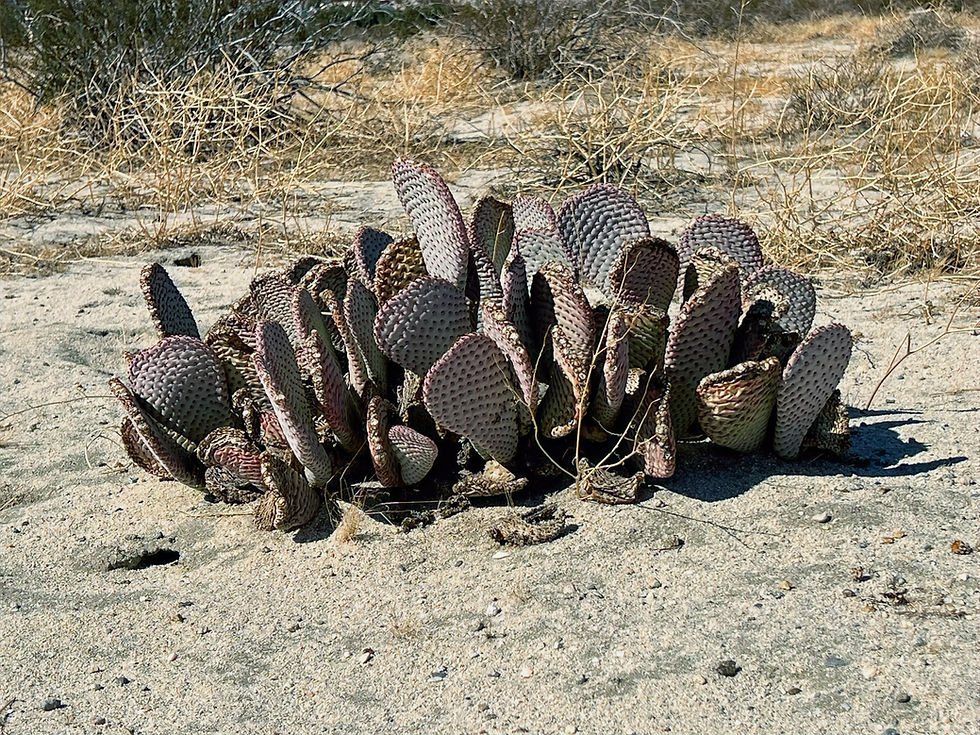
... and silver cholla.

As we continue hiking, the trail begins to transform into a wash carrying runoff from the hills.

Despite the numerous warning signs that OHVs are not allowed in this reserve, it’s obvious vehicles are operating here without any impunity. I’m not against OHV access in designated areas but the miles of off-road tracks here are undeniably destroying critical habitat the reserve was created to protect.

The Geological Forces that Create This Unique Terrain
The landscape around the Kim Nicol Trail is a fascinating meeting point between mountain erosion and wind-driven sand transport, creating one of the most distinctive desert habitats in North America.
Mountain Erosion
The Little San Bernardino Mountains, just north of the trail, are steep, rocky, and composed of fractured granitic and metamorphic rock. Occasional intense desert storms trigger flash floods that rush through the canyons and washes.

These torrents carry gravel, cobbles, and coarse sand — collectively called alluvium — out of the mountains and onto the valley floor.

Over hundreds of thousands of years, repeated floods have built up a broad alluvial apron, or fan, of rocky sediment.

Wind-Driven Sand Transport
From the west, powerful winds (black arrows) funnel through the San Gorgonio Pass, sweeping fine sand particles across the valley. When the wind loses energy, often at the base of the Indio Hills, the sand particles settle out, forming active and semi-active dunes.

The Kim Nicol Trail lies right along this sand transport corridor (blue circled area). Here, sand continuously settle over the older alluvial surface from the Little San Bernardino Mountains, forming blowsand dunes and sandy flats.

On the surface it may look like just a sand pile but underneath the sand is a complex multistory landscape. One of the best places to see this process frozen in time is the walls of this wash. Coarse, jumbled layers of rock fragments and gravel deposited by past floods (labeled A) overlain by finer windblown sand (labeled B). The alternating cycles of water-driven and wind-driven deposition that continues to shape this terrain.

After 0.6 miles it’s time to leave the wash and follow this steep, sandy trail that leads to the rocky terrace and hills.

The climb to the terrace and the beginning of the Indio Hills landscape involves a gradual climb of 200+ feet. At this point, the trail divides and I opted to hike clockwise to tackle the elevation gain first.
Desert Scrub Habitat
The typical desert scrub plants creosote and bursage dominate the terrain. The older, rocky alluvial deposits washed down from the Little San Bernardino Mountains create a stable, gravelly foundation for their roots.

Even cacti sometime succumb to the extreme conditions encountered here.

In areas where rainfall does not pool or collect, the creosote are leggy and exhibit signs of drought stress. Mature plants will shed leaves and may experience stem dieback during prolonged dry periods to conserve water. During extreme drought, the plant can drop its leaves and go dormant, then quickly re-leaf after rain. Photo taken in early fall.

A short distance away where water is more available, the plants are more dense, have darker green leaves and maintain more of a 'shrub' shape. This hardy evergreen has remarkable adaptations to heat and drought. Its deep, extensive root system can tap moisture from far below the surface while also spreading laterally to capture rare rainfall. Photo taken in early winter.

A side-by-side comparison of a stressed creosote (left) vs more healthy creosote (right). Its small, waxy leaves reduce water loss are an adaption to the extreme temperatures it endures living in one of the hottest and driest desert in North America.
Seeing juvenile creosote plants is important because it shows the desert ecosystem is functioning, as these young plants indicate that older plants are providing shelter and nutrients for new life and that the species is able to reproduce.
Less than 1% and in many populations virtually 0% of new creosote shrubs originate from germinated seeds. Seed germination does happen, but only in rare, ideal conditions, typically after unusually heavy rainfall, mild temperatures, and when soil crusts are disturbed enough for seeds to penetrate. Even then, seedling survival is extremely low, as most die from drought or heat stress before establishing deep roots. Most population expansion occurs by vegetative reproduction, where a mature plant’s root system sends up new stems that gradually form a ring or clone.

Ecologically, creosote provides shelter, shade, and microhabitats for countless desert species including kangaroo rats, lizards, and insects. There were at least 10 small burrows at the base of this creosote. These burrows provide a cooler place to hide during the extreme heat of the day and a warmer refuge when temperatures drop at night. A quick dive into a burrow can also help a lizard evade a predator.

This kangaroo rat wasn't as fortunate in reaching its burrow to escape a predator.

Here is a photo of a healthy kangaroo rat from iNaturalist. These rodents are known for their remarkable adaptations to arid conditions, such as surviving without drinking water by getting moisture from seeds and plants. They have large hind legs for hopping and long tails for balance, and live in burrows to escape extreme temperatures.

Sand Traps - Flora
In the rugged landscape of the hills, vegetation and topographical features (such as washes, depressions, rocky outcroppings, etc.) function as 'sand traps.' These barriers reduce wind speed, leading to the accumulation of sand. The sand in these traps varies from shallow to moderate in depth and often combines with gravel and soil, becoming more compact over time. The primary difference between 'sand traps' and 'sand dunes' is that traps are passive; sand accumulates and stays undisturbed, while in active sand dunes, the sand is constantly moving. This photo illustrates a typical sand trap environment.

This mixture of sand and gravel creates an ideal habitat for wildflowers, such as these notch-leaf scorpion weed and narrow-leave cryptanthus as well as these …
... desert sunflowers.


Sand Traps - Fauna
As the path climbed yet another hill, I noticed a desert horned lizard among the rocks. It was difficult to spot once it move because it camouflages effectively with the surrounding sand. These lizards, ranging from 3 to 5 inches long, have a distinctive, flattened, toad-like look and can be easily identified by the spines or "horns" on their heads and the fringes of scales along their bodies. The home range of an individual desert horned lizard is generally limited, usually spanning about 59–74 feet in diameter, which means they don't make use of the wildlife corridor offered by the reserve. Their diet is primarily insect-based, with harvester ants being a major component, constituting up to 90 percent of their intake.

Western whiptail lizards are commonly found in stabilized sand traps. The soft, shifting sand in the dunes is not firm enough to support their rapid, darting movements as they hunt for prey.

At the 2-mile point, you arrive at the trail's highest elevation (an 840-foot gain) which provides excellent views of San Jacinto and ...

.... the Indio Hills with the Santa Rosa Mountains in the background. Its also where active sand dunes become more common.

Active Sand Dunes - Flora
Long before highways and golf courses carved up the valley, wind blown sands moved freely across miles, replenishing dunes in a living cycle. Development has fractured that system, but in places like Kim Nichol trail, wind continues to shape the landscape. Fine grain of sand carried from the San Gorgonio Pass are swept eastward and begin collecting on low ridges in the Indio Hills. Dunes form where the wind slows down, creating areas where sand moves with every gust as it migrates across the landscape.

The dunes creep every so slowly constantly reshaping the ground. Windblown ripples are a common sight on active dunes.

The landscape may look barren at first, but shifting sand is the foundation for a specialized community of plants and animals that are perfectly adapted to the constant motion, extreme heat, and scarcity of resources within the dunes.

Each of the following dune plants are specialists use slightly different strategies to survive in the shifting sands of Kim Nicol Trail. These plants highlight how life in the dunes is about adaptation to changes and not resisting the wind and sand.
Desert Sand Verbena
Strategy: Fast life cycle and flexibility
Desert sand verbena germinates and spreads quickly across the sand after winter rains and blooms within weeks, completing its life cycle before higher temperatures return to the dunes. It has sticky, sand-trapping stems and leaves, which act as a protective "sand armor" that deters herbivores. This adaptation also helps the plant conserve moisture and provides physical protection from wind-blown sand. Seed can remain dormant for years, germinating only after ideal rain and temperature cues


Dune Evening Primrose
Strategy: Root depth and sand anchoring
Even though the surface of a dune is typically bone dry, below the surface sand dunes hold on to what little rain falls each year. The deep taproot of the Dune evening primrose reaches the hidden moisture which sustains the plant throughout its rapid life cycle. In addition its rosette of leaves catch windblown sand, creating mini dunes that protects its base and helps to trap even more moisture. Seeds are well adapted to burial and transport by sand.

Dune evening primrose flowers bloom at night using large white flowers and the plants strong fragrance to attract nocturnal pollinators like moths. This strategy allows the plant to avoid competition from diurnal pollinators. As its name implies, the flowers close in the morning to minimizes the surface area exposed to the sun and air, in order to conserve water and prevent dehydration.

Coachella Valley Milkvetch
Strategy: Endurance in motion
Coachella Valley milkvetch is one of the Valley's rarest plants, found only in the shifting sands, areas that are too unstable for most plants. Beneath the surface a surprisingly deep root system anchors the plant against moving sand and helps it reach hidden moisture. The plant is densely covered with silky, white hairs, and blooms between February and May producing flowers that range from pink to deep magenta. Unlike shrubs that need stable ground, milkvetch is built to keep pace with the wind, tolerating partial burial and resurfacing as dunes shift around it. Seed from this milkvetch can remain dormant underground for years until rare favorable conditions allow germination.


In the spring multiples species of grasses including big galleta (left) and sand ricegrass (right) grow on the margins of the active dunes. Even these native grasses can become a problem. The anchor blowing sands, slowing the natural sand shifting environment essential for fringe-toad lizards and dune wildflower.
In the wrong location, both native and non-native grasses can unintentionally reshape a fragile dune system.

Active Sand Dunes - Fauna
The active dunes also host a community of reptiles that have adapted to the shifting sands along the trail. The most iconic being the Coachella Valley fringe-toad lizard, a small sand-dwelling lizard that is perfectly tuned to life in the dunes. It is a protected species, listed as threatened by the U.S. and endangered by California, and its survival depends on specific windblown sand habitats in the Coachella Valley. Today, its habitat has been reduced to about 50 square miles, but only about 19 square miles of this land continues to receive the naturally occurring 'blowsand' that is essential to the long-term survival of the species.
Everything about the fringe-toed lizard is engineered for survival on shifting dunes. Its body is light and sandy-colored, providing instant camouflage. The most distinctive feature, however, is its fringed toes—tiny, comb-like scales that widen the surface area of each foot. These act like snowshoes, preventing the lizard from sinking while allowing it to sprint across soft sand faster than predators can react. When threatened, it simply dives beneath the surface and disappears, using a flattened head, wedge-shaped snout, and smooth belly scales to 'swim' through sand with astonishing ease. The lizard’s physiology is equally remarkable. Specialized nasal valves keep sand from entering its lungs, and it can tolerate the extreme heat of dune surfaces that often exceed 140°F. Its diet consists mainly of small insects and flowering dune plants such as sand verbena. I feel incredibly lucky to capture this photo on a Coachella Valley fringe-toad lizard that was classified as an iNaturalist research grade observation.

Don't forget to look down; the dunes are filled with subtle signs of creatures that call the dunes home. The small V-shaped tracks were almost certainly made by a roadrunner while the longer tracks (right of center) were most likely made by a sidewinder rattlesnake. These tracks may have been made during an encounter between a roadrunner and a sidewinder. This confrontation is one of the desert's most intense predator-versus-predator battles which typically results in the roadrunner's victory.

A short distance away, I came across the mostly intact remains of a sidewinder rattlesnake. The photo shows:
Approximately 2-inch section missing near the head/neck.
Another similar section missing from the tail region.
Mid-body completely intact.
Carcass lying fully exposed on open dune sand.
No signs of crushing, no vehicle tracks, no overall trauma.
This damage pattern strongly matches avian predation, especially a roadrunner or raptor. A coyote attack would leave larger, more ragged tears and they often drag or reposition the carcass. This one looks surgically pecked.
It appears the sidewinder was attacked by a roadrunner. The missing head and tail sections are typical roadrunner feeding pattern. Also the intact midsection plus the fact it was found in open sand location further points to a roadrunner kill.

I spotted another track (wavy line) in the dunes. This time it was from a Mojave shovel-nosed snake. They are a non-venomous, burrowing desert snake known for its spade-shaped snout and smooth, yellowish or cream-colored body with dark bands. These nocturnal snakes are well-adapted for life in sandy desert habitats, where they 'swim' through loose sand to hunt for invertebrates like insects and scorpions, and spend the hottest parts of the day buried underground. So there was very little chance of seeing this snake during the middle of the afternoon. Snake photo courtesy of USGS.
Seeing these snakes and their tracks helps to drive home the importance of being smart and cautious while hiking in the desert. Educate yourself on ‘snake safety’ and become a responsible hiker.

There are more than snakes and lizards out here. At first glance, this D-shaped burrow looks like a desert tortoise’s home. despite the shape being similar, Kim Nicol dunes sit far outside tortoise habitat. Also the sand is too loose to hold a tortoise tunnel, the opening is a little small and there are no large shell drag marks at the entrance. This burrow was almost certainly created by a round-tailed ground squirrel, the most common burrow-maker in the Kim Nicol environment.

Raptors, including this red tail hawk, are a regular sight at the Kim Nicol Trail. They soar there because the dunes generate perfect flight conditions and the landscape supports an abundant buffet of small mammals, reptiles, and birds. Unfortunately, the trash and debris discarded along the trail pose a hazard to these raptors.

However, the more disturbing tracks are those made by humans. Unfortunately, ATV traffic is heaviest in the most sensitive area — active sand dunes. These vehicles cause severe, long-lasting damage to this ecosystem.

ATV tires compact and churn the sand which prevents the natural wind-sculpting process that keeps dunes active and mobile. Tire tracks create hardened crusts that can last for months or even years .
A single pass can crush or uproot dune plants and destroy burrows.
ATVs can carry seeds of invasive Sahara mustard and other weeds that easily outcompete native dune plants.
Even hikers can cause harm by walking off-trail or stepping on young sprouts near the path. It's everyone's job to recreate responsibly!

A Short Green Gully
After about 2.5 miles, the blowsand environment started to vanish, and we entered a narrow gully with traditional Indio Hills geology formed by flash floods and debris flows.
Summer monsoons and winter rain events release large volumes of water but because of the hard packed soils very little of the rain soaks in where it falls. Instead it runs off the slopes of the Indio Hills and San Bernardino Mountains.

Monsoonal rains fuel plant life in these hills by sending nutrient-rich water pulses through gullies and washes. Plants in these locations are adapted to capture and store any rain that falls, creating lush corridors of life in an otherwise parched desert. Despite scorching summer temperatures, this cattle saltbush has produced new leaves in response to summer rains. After a significant rain pulse, the shrub can leaf out within days.

During the spring and summer, these leaves may last 2-6 weeks before drying and being shed. Saltbush shrubs don't lose leaves all at once; they keep a mosaic of old and new leaves allowing photosynthesis even in drought. New leaves begin green but as salts accumulate on their surface (from rain water percolating through salty soil) they become pale gray-green.

After even modest rainfall, desert holly increases stem hydration and leaf water content. The plant doesn’t always produce a dramatic flush of new leaves like other saltbush species, but it revitalizes existing leaves, improving photosynthetic efficiency. Unlike many desert shrubs, desert holly rarely sheds all its leaves during extreme drought. Its leaves are tough, long-lived, and designed to persist through multi-year dry spells. It simply shrinks its physiological activity, slows photosynthesis, and waits for the next pulse.
California croton has a shallow but wide root system perfectly designed to capture the thin layer of water that infiltrates sandy soils. Within days of a rain pulse, the stems become more hydrated, and new growth begins. These leaves remain for weeks or months depending on how long the soil stays damp. In prolonged drought, croton drops many of its younger leaves but retains older, tougher ones.
After a steady climb out of the gully, we are surrounded by desert scrub on the bench that straddles the hills. Summer heat has taken a toll on this plants community.

With all the loose sand and rolling hills how did they even get this car to this location? But more importantly, why would you chose a conservation area chose as its final destination; it's inexcusable.

Conservation Challenges
The picture above highlights the challenges faced by the Coachella Valley Conservation Commission whose role is to work with the various permittees, including local governments and state agencies, to safeguard habitats and endangered species including those within the Kim Nicol area.
Development Pressure
Housing, roads, and golf courses block sand corridors. including the area at the trail head and on the trail boundaries.
Invasive Species
Tamarisk trees and Sahara mustard choke native dune flora. After a wet fall the dunes are covered in mustard (left) and seedlings are already piercing the surface (right).
Its fast growth allows it to out-compete native plants for resources like sunlight, water, and nutrients.
Recreation Impact
The numerous photos included earlier that show disregard for the limitation on OHV restrictions on Kim Nicol Trail.

Illegal Dumping
Despite the Commission's best efforts to control it, the trail is littered with illegally dumped small and large items.
Even with these setbacks, Kimberly Nicol, a committed biologist and conservationist known for her relentless efforts to safeguard the delicate ecosystems of the Coachella Valley, and after whom this trail is named, would continue her advocacy that human recreation and wildlife survival can coexist — but only if we make wise decisions.
More Sandy Slogs
The rest of the journey back to the trailhead featured a mix of loose, soft sand and compact soil, with plenty of hills thrown in to make the hike more memorable!

At approximately the 5.25-mile point, we complete the lollipop section of the trail, and it's now a matter of descending back into the initial wash to hike the final segment back to the trailhead.
The more I visit Kim Nicol, the more I appreciate its ordinariness. If you are coming to share social media photos that will wow friends and family, you are going to leave underwhelmed and disappointed. The trail is subtle. The vistas are broad. The vegetation is sparse. The sand is unrelenting. But hidden in that ordinariness is an extraordinary truth: this trail protects an ecosystem on the edge, one that exists nowhere else. Each time someone walks here, sees a fringe-toed lizard, or learns the name of a dune flower, that protection becomes stronger.

Come hike Kim Nicoll and see firsthand that conservation sometimes looks ordinary — like a hilly trail covered in soft sand or a stretch of drought stricken shrubs. See why Kimberly Nicol fought so hard to protect this ordinary looking area of the Coachella Valley. Thanks also to the Coachella Valley Mountain Conservancy, which helped fund the trail creation, and to the volunteers from Friends of the Desert Mountains who assisted in constructing the trail.
151025


