Hike Hidden Palms Oasis: A Quiet Desert Sanctuary in the Indio Hills
Updated: Jul 19
Hike Details
Location: Indio Hills
Trail Type: Loop
Distance: 3.38 miles
Elevation Gain: 842 feet
Difficulty: Moderate
Terrain/Obstacles: Narrow and eroded trail as it climbs from the wash onto the plateau and then again climbing from the oasis back onto the plateau
Hike Breakdown: Hike is suitable for novice hikers who want a challenge
Best Time: October - May
Highlights: Hiking on the San Andreas Fault system, desert fan palm oasis

TrailsNH Hiking Difficulty Calculator: 75 – Moderate
Click here to navigate to the TrailsNH website for a description of the hiking difficulty calculator.
Here is a satellite view of the Hidden Palms Trail with mile markers included.

Why Hike to Hidden Palm Oasis
Unlike the broad palm groves at Pushawalla Palms and Willis Palms, Hidden Palms remains hidden until the trail rounds the final bend. What begins as a hike through dry washes, rocky hills, and sparse desert vegetation slowly changes with each step. The washes become greener, shrubs grow taller, and then, almost without warning, a grove of towering California fan palms appears, an unmistakable sign that groundwater lies just beneath the surface. It’s this sense of discovery that makes Hidden Palms one of the most rewarding short hikes in the Greater Palm Springs area.
Let's Start Hiking
Some desert hikes reveal their treasures slowly. Hidden Palms begins in a broad sandy wash at the base of the eroded Indio Hills. At first glance, the landscape appears stark, with scattered shrubs, rounded cobbles, and steep sedimentary hills rising ahead.
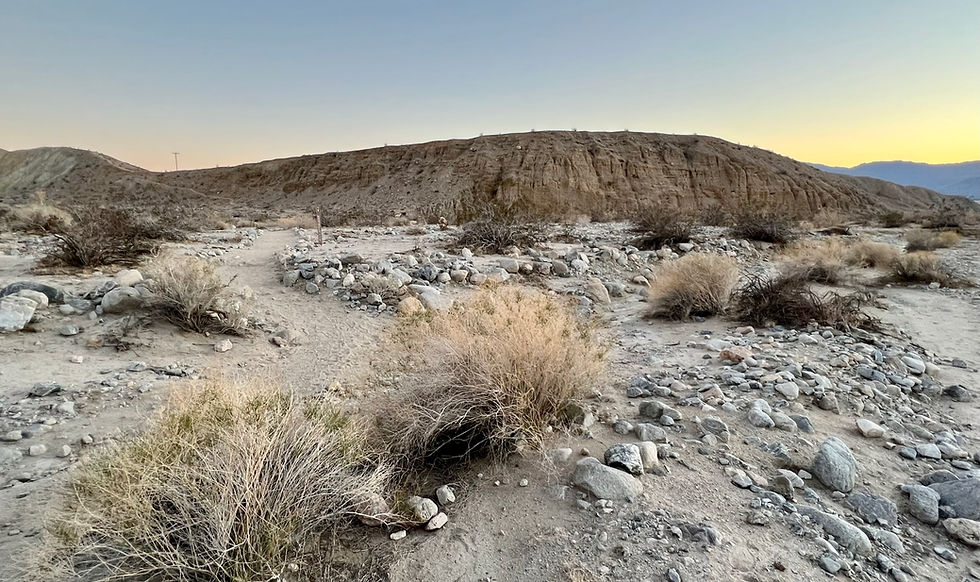
Yet even here, life has adapted to one of the harshest environments in the Colorado Desert. During dry years, hardy shrubs such as cheesebush dominate the wash, surviving on moisture stored beneath the sandy surface while withstanding both prolonged drought and the occasional flash flood.

After a wet winter, however, the wash takes on a different character. Dormant seeds awaken, and patches of grasses and wildflowers briefly carpet the sandy floor, adding color to a landscape that often appears lifeless.


Though short-lived, these colorful displays offer a reminder that the desert is far more than a stark, brown, dry environment.
At twilight, the wash and the jagged silhouette of the San Jacinto Mountains create one of the most striking desert vistas along the trail.

The Desert Begins to Rise
As the trail continues, the broad wash narrows, and the walls of the Indio Hills begin to close in. Ahead, the route bends alongside a low ridge where the landscape bears the scars of past floods. The base of the ridge is almost completely stripped of soil, vegetation, and loose rock, a reminder that desert washes are always in a state of change. During intense storms, walls of water surge through the canyon, scouring the landscape like a natural bulldozer before disappearing as quickly as they arrived.

The powerful flash floods that periodically bulldoze the base of these hills are also slowly reshaping them. The hills are composed of loosely cemented layers of sand, gravel, and cobbles deposited by ancient streams, and debris flows that once poured out of the surrounding mountains. Scattered throughout these sediments are massive granite boulders, far too large to have been moved except by exceptionally powerful floods millions of years ago.
Today, erosion is reversing that process. Each flood washes away more of the surrounding sediment, gradually exposing the buried boulders until they are left perched precariously on the hillside. Eventually, gravity takes over, sending them tumbling into the wash below, where future floods may carry them farther downstream. Over the past one to two million years, uplift along the San Andreas Fault raised these ancient deposits to form the Indio Hills, while erosion has continued to carve them into the landscape you see today.

What a Difference Rain Makes
Despite its harsh appearance, this landscape is constantly changing. Both of these photos were taken in nearly the same location on the trail. During dry years, the wash appears barren, with only scattered shrubs dotting the pale desert floor. However, after a wet winter, dormant seeds hidden beneath the sand awaken and transform the landscape into a patchwork of green plant islands.
After rounding the cliff face, the trail leaves the wash and begins a short but steep climb.

The Plateau: Drier, Exposed, and Older
After the climb, a broad plateau unfolds with expansive views in every direction.

Gone are the sandy washes and taller shrubs, replaced by a rocky surface scattered with creosote bush, white bursage, beavertail cactus, and pencil cholla. These hardy plants are well adapted to the plateau’s thin soils, intense sunlight, and limited moisture.
beaver tail cactus on Hidden Palms Oasis trail pencil cholla on the Hidden Palms Oasis trail
Unlike the washes below, where water and nutrients accumulate, rainfall on the plateau quickly evaporates or runs off the rocky surface. Greater exposure to sun, wind, and temperature extremes further limits the variety of plants that can survive.

Even so, the landscape is far from uniform. In some areas, shallow depressions collect runoff, sediment, and windblown seeds, creating pockets of dense vegetation.

These sheltered areas retain moisture longer after rain, allowing plants to become established and gradually create their own favorable microhabitat. The result is a patchwork landscape in which isolated thickets stand out against the otherwise dry and rocky plateau.
yellow flowers on brittelbush growing on the Hidden Palms Oasis trail small yellow flowers on creosote shrub growing on the Hidden Palms Oasis trail
The rocks covering the plateau tell another story. Many are coated with desert varnish, a dark mineral film that accumulates extremely slowly over thousands of years.

Its presence suggests these rocks have remained exposed and largely undisturbed for long periods, making the plateau one of the oldest and most stable landscapes along the Hidden Palms trail.

At the first major junction, we bear right and begin a gentle descent from the plateau.

As the trail drops into a shallow wash, the plant community gradually changes. Shrubs grow taller and closer together, and the plant community becomes more diverse, signaling that water is more readily available beneath the sandy channel.

One of our favorite stops along this stretch of the trail is a broad stand of desert lavender. Its soft gray-green foliage and delicate lavender flowers add color to the wash, but it’s the leaves that make the biggest impression. Gently rub a single leaf between your fingers to release its unmistakable herbal fragrance. To help protect these native shrubs, enjoy the aroma using just one leaf and leave the rest of the plant undisturbed.
Desert lavender shrub growing in the wash leading to Hidden Palms Oasis
An unexpected discovery along this stretch of trail was a patch of flowering hairy milkweed, not commonly encountered on this hike. Hairy milkweed produces clusters of creamy white flowers that attract a variety of native bees and butterflies and serve as a host plant for monarch caterpillars.
First Glimpse of Hidden Palm Oasis
The sign says it all.

After a few feet, the trail crests a gentle rise, and Hidden Palm Oasis comes into view. Nestled among the rocky hillsides, the cluster of towering desert fan palms is a rewarding sight after the hike across the plateau and open washes.

Why Hidden Palm Oasis Exists
Hidden Palm Oasis is much more than a beautiful grove of California fan palms. It is the visible expression of groundwater moving beneath the desert—water that fell as rain in the nearby San Bernardino and Little San Bernardino Mountains before slowly traveling underground through the Coachella Valley.
Here in the Indio Hills, the Banning Fault, a major strand of the San Andreas Fault system, helps create the conditions needed for an oasis. Over hundreds of thousands of years, fault movement uplifted and fractured the sediments while placing permeable sands and gravels against less permeable layers of clay and silt. These underground barriers slow the movement of groundwater, keeping it close enough to the surface for plants to thrive.
This dependable source of moisture allows California fan palms to flourish where they otherwise could not, transforming an otherwise dry wash into a secluded desert oasis.
Listening to the Water Below
Near the oasis, we came across an open pipe that appears to be a groundwater monitoring well. Curious, we dropped a small pebble into the pipe and, almost immediately, heard a distinct splash. The surprisingly short delay revealed just how close the groundwater lies beneath the desert surface.
An Oasis Is More Than Palm Trees
At first glance, Hidden Palms appears to be simply a cluster of towering California fan palms rising above the desert. Step beneath their canopy, however, and you'll discover an entirely different world.

The palms provide welcome shade from the relentless sun, helping the air remain slightly cooler and more humid than the surrounding desert. The moist soils support a variety of shrubs, grasses, and wildflowers that would struggle to survive just a few hundred feet away. Together, these plants create food and shelter for birds, insects, reptiles, and other wildlife, making the oasis one of the most biologically diverse habitats in the desert.

One of the most common plants growing beneath the palms is arrowweed, a tall native shrub that thrives where groundwater is close to the surface. Its dense thickets provide shelter for birds and other wildlife while helping stabilize the sandy soils around the oasis.

A Hidden Home for Great Horned Owls
The towering California fan palms provide more than shade; they also offer safe nesting and roosting sites for wildlife.

One of the oasis’s most impressive residents is the great horned owl, a powerful nocturnal predator that often nests high among the protective canopy of mature palms. Great horned owls are among the desert's most formidable nocturnal predators, using exceptional night vision, acute hearing, and nearly silent flight to hunt in complete darkness. Their powerful talons allow them to capture prey ranging from rodents and rabbits to reptiles and even other birds.
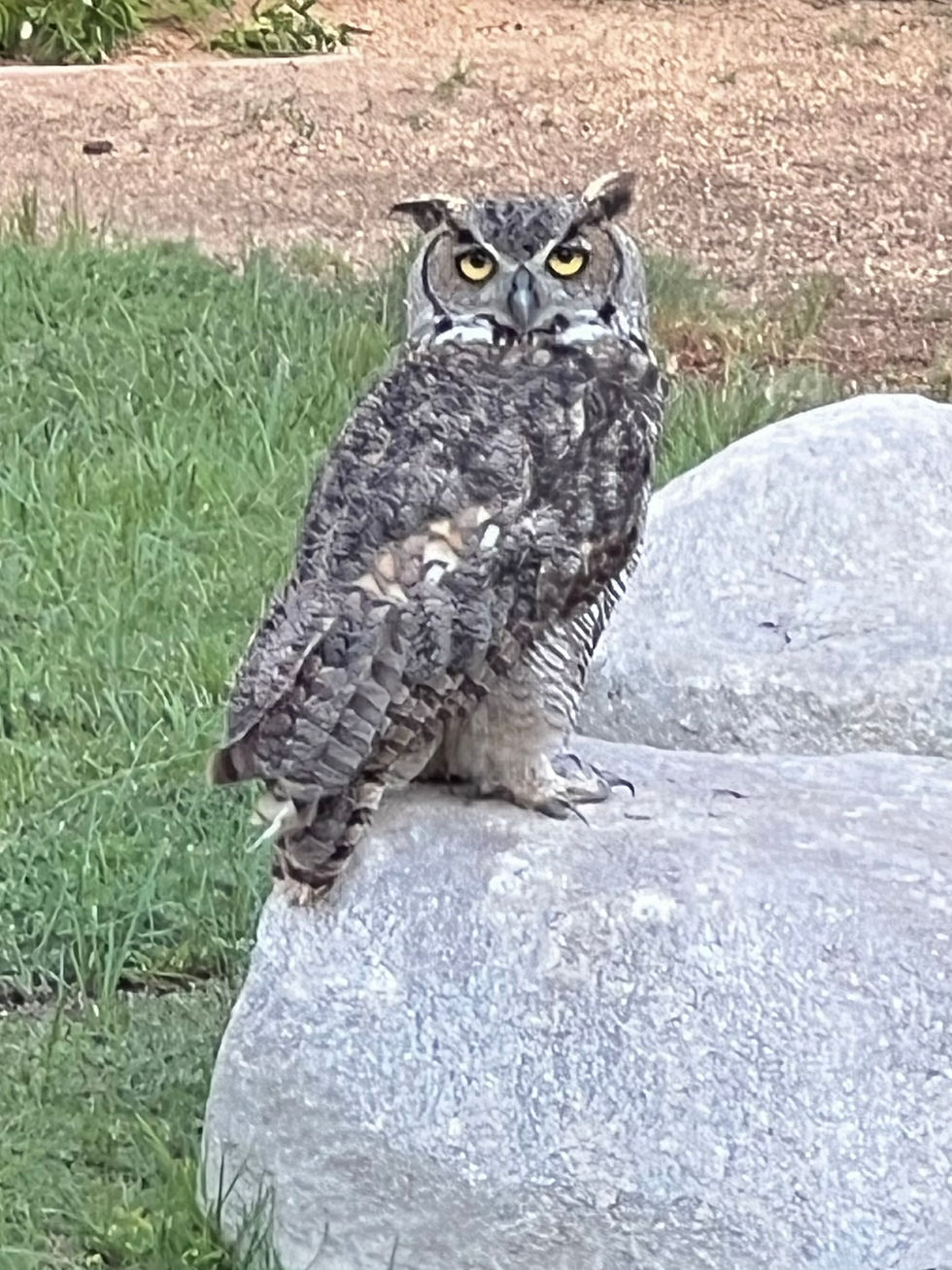
At the base of one palm, we discovered a collection of owl pellets mixed with the bones and fur of rodents. Great horned owls swallow much of their prey whole, then later regurgitate the indigestible bones, teeth, and fur as compact pellets. The pellets reveal the owl's diet and provide strong evidence that these nocturnal hunters regularly roost or nest within the palm grove.

The great horned owl is just one example of the many species that depend on these desert oases. In many ways, a palm oasis functions like an island. Surrounded by miles of hot, dry terrain, it offers reliable water, shade, and food in an otherwise inhospitable landscape. For countless species, these isolated groves are not simply places to visit; they are essential refuges that have sustained desert life for thousands of years.
The oasis itself, however, depends on the continued renewal of its most iconic resident, the California fan palm. Like every living organism, each palm follows a remarkable life cycle that begins with a single seed and unfolds over decades.

The Life Cycle of a California Fan Palm
Every towering California fan palm begins as a single seed. In late spring and early summer, the palms produce long clusters of creamy-white flowers that attract a variety of pollinators.

By late summer, the palms produce dense clusters of small, dark purple to black fruits, each containing a single seed.
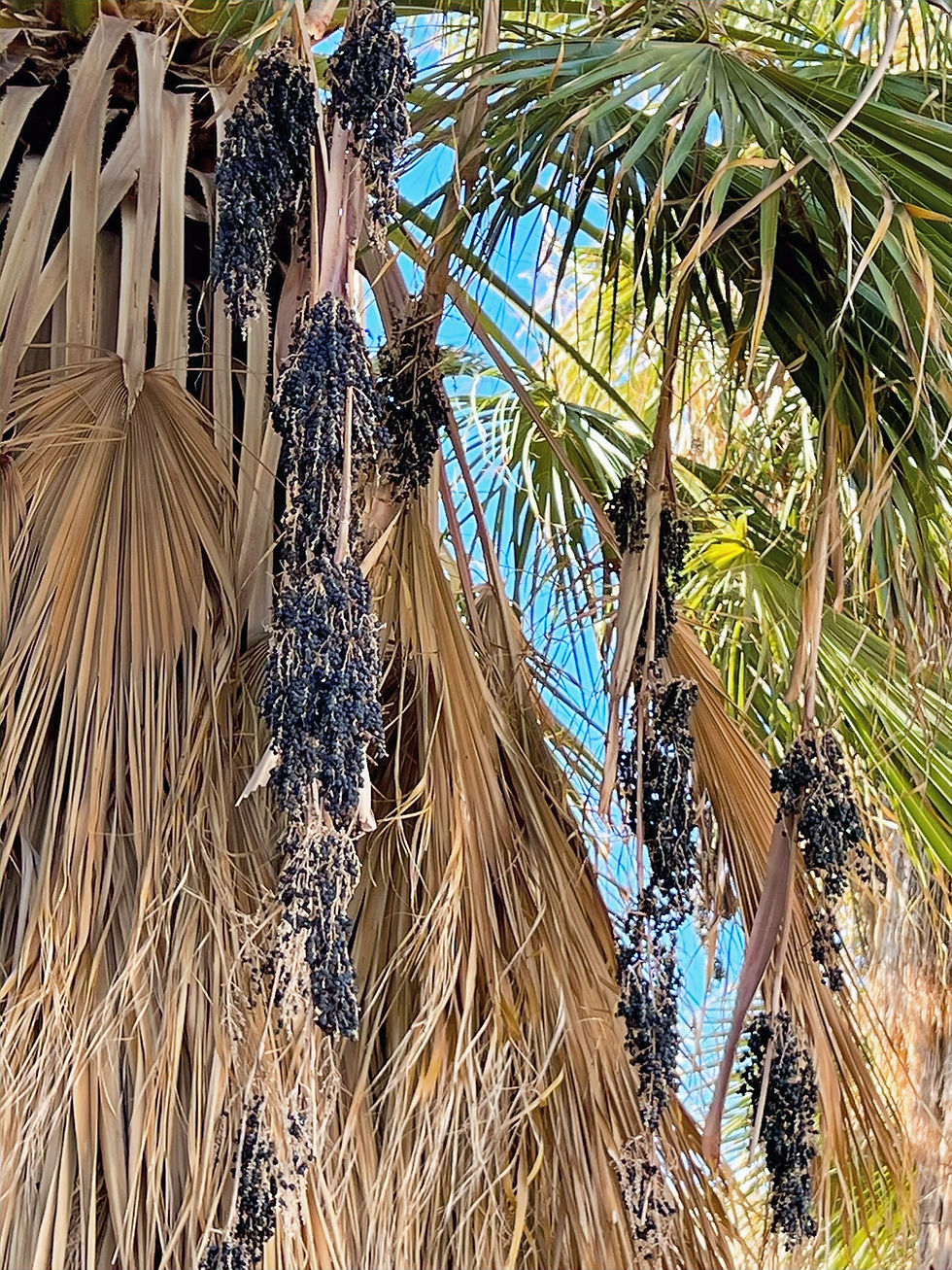
These sweet fruits provide an important food source for birds, coyotes, and other wildlife. Along the trail, we came across coyote scat filled with palm berry remnants, a fascinating reminder that coyotes play an important role in dispersing seeds throughout the oasis.

As the animals travel the desert, they deposit the seeds in new locations, where only a fortunate few land in moist soil with enough groundwater to germinate. This young California fan palm is one of those success stories. A seed, carried here by wildlife, found the rare combination of water and favorable conditions needed to take root. Given enough time and a dependable supply of groundwater, it will eventually grow into one of the towering palms that define Hidden Palms Oasis.

As seedlings mature, they produce a crown of fan-shaped leaves while slowly building the trunk that will eventually lift them above the surrounding vegetation. The abundance of young palms growing alongside mature trees is one of the clearest signs of a healthy oasis. The new generations are continually taking root and replacing older ones.

Over decades, older leaves die but often remain attached, forming the familiar ‘skirts’ that drape around the trunks. Throughout Hidden Palms, these dense skirts are one of the defining features of mature California fan palms. Far more than a collection of dead fronds, they provide shelter and nesting sites for birds, bats, insects, and other wildlife, turning each mature palm into a miniature ecosystem.

Even the end of a palm’s life supports the oasis. When an aging tree finally collapses, whether from old age, fire, or a powerful flash flood, it returns nutrients to the soil and creates space for new seedlings to grow. It’s a continuing cycle of renewal that has sustained this oasis for thousands of years.

A Fragile Desert Sanctuary
Today, the oasis faces new challenges that threaten the delicate balance on which it depends. Invasive plants, prolonged drought, and a warming climate place increasing stress on the oasis.
Even well-meaning visitors can unintentionally damage this fragile habitat by trampling young seedlings, disturbing wildlife, or venturing off trail. By respecting the oasis and following Leave No Trace principles, we can help preserve this remarkable ecosystem.

The Return Journey
Leaving the oasis behind, the trail retraces its route across the open desert. The cool shade of the palms gradually gives way to the broad, exposed sandy wash. In the distance, Horseshoe Palm Oasis offers a tempting glimpse of another hidden refuge, but that is an adventure for another day.
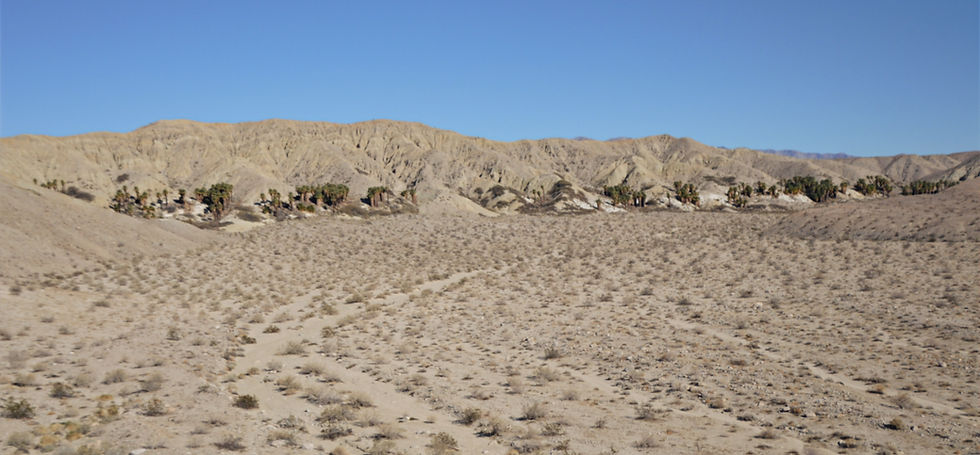
As the trail follows the wash, patches of Mojave desert star and narrow-leaved cryptantha brighten the rocky margins where the wash meets the surrounding hills. These annual wildflowers flourish in the well-drained gravelly soils, where winter runoff supplies just enough moisture for a brief display of spring color before the desert quickly dries again.


Eventually, the trail leaves the wash and follows a narrow goat trail up the side of the plateau.

A short walk across the plateau brings us back to the trailhead, concluding a memorable hike to one of the Indio Hills hidden desert oases.

Closing Thoughts
Hidden Palms offers a different experience from the other palm oases in the Indio Hills. While Pushawalla Palms is known for its expansive palm groves and Willis Palms showcases the influence of the San Andreas Fault, Hidden Palms rewards hikers with a quieter setting where the geology, wildlife, and oasis ecosystem can be appreciated at a slower pace. Whether it's your first visit or a return trip, this hidden oasis is well worth exploring.
Continue Exploring the Indio Hills Palm Oasis Series
Each oasis has its own story to tell:
Hidden Palms — A secluded and peaceful desert oasis.
Pushawalla Palms — Fault-shaped canyons and expansive palm groves.
Willis Palms — Springs, wildfire recovery, and the living influence of the San Andreas Fault.
Continue Exploring the Desert Fan Palm Oasis Series
New to California’s desert fan palm oases? Learn how these remarkable ecosystems form, discover their unique ecology, and explore more of the state’s finest oasis hikes in our California Desert Fan Palm Oases: The Complete Guide.
Looking for your next adventure? Browse Best Desert Fan Palm Oasis Hikes in Southern California to compare the region's most spectacular oasis trails and find the one that's right for you.


